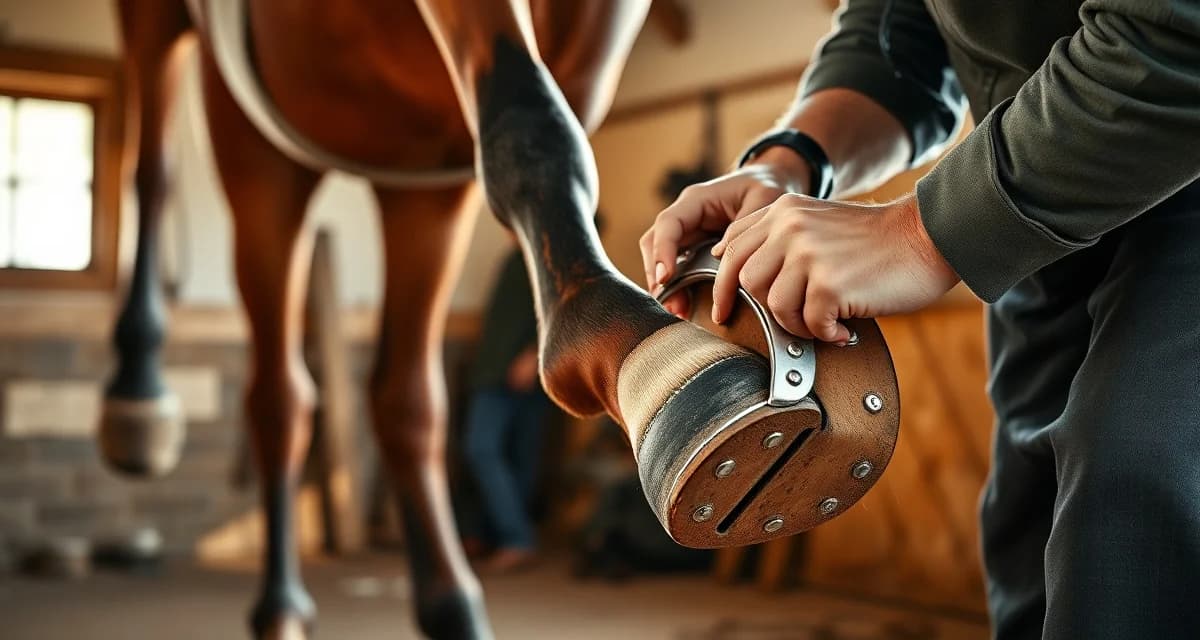
Standardbred Retirement Shoeing Guide: Transitioning Harness Racers to Trail and Pleasure
More than 60,000 Standardbreds retire from racing annually in the US. A growing number of them are finding second careers as trail horses, pleasure riding horses, and even mounted sport horses. They're trainable, level-headed, and naturally gaited in a way that makes them comfortable to ride once they've adjusted to life off the track.
TL;DR
- Over 60,000 Standardbreds retire from racing in the US each year, and many need a structured shoeing transition to succeed as trail or pleasure horses.
- Racing shoeing uses toe weights, gait-specific angles, and interference-preventing equipment that must be removed at the first retirement visit.
- The transition typically takes 3-4 shoeing visits over 3-6 months, with visits every 4-6 weeks during the adjustment period.
- Hoof quality issues common in track horses, including contracted heels, thin soles, and long white line, can extend the transition timeline and should be documented at every visit.
- Shoeing can influence whether a retired Standardbred trots or paces under saddle, making owner communication about riding goals essential before adjusting angles or weights.
- Once a stable setup is established, most retired Standardbreds shift to a standard 6-8 week pleasure horse maintenance schedule.
The shoeing transition is one of the most important parts of that adjustment. Racing shoeing is built around harness racing's specific mechanics. Pleasure and trail shoeing is built around something entirely different.
Racing Shoeing vs. Retirement Shoeing
Standardbred racehorses are shod to optimize the pace or trot specific to harness racing. The shoe setup affects the horse's gait timing, limb clearance (avoiding the interference that comes when a leg hits another leg during the stride), and the way the foot breaks over at speed.
Racing shoes on Standardbreds are often weighted or modified with toe weights, pads, or different shoe configurations on different legs to time the gait correctly. The hoof angles may be set higher or lower than what would be natural for the horse in pleasure work. Knee boots and gait equipment complete the racing setup.
In retirement, all of that changes. The horse no longer needs gait timing equipment or interference-preventing shoeing. It needs a balanced foot that's comfortable for walking, trotting, and cantering under saddle.
The Transition Process
FarrierIQ's hoof health records are genuinely useful for documenting the retirement transition. You're tracking where the horse started, what changes you made at each visit, and how the horse's movement and soundness responded.
A typical transition might look like:
- First visit: assess the current shoeing, remove any racing-specific equipment, apply a basic balanced shoe
- Second visit: evaluate how the horse moved under saddle and adjust angles as needed
- Third visit: confirm the setup that works for the horse's new life and establish a maintenance interval
Some Standardbreds transition smoothly in two or three visits. Others have hoof quality issues from the track environment, contracted heels, thin soles, or long-term angle compensations, that take longer to address. Document everything.
Gait Considerations
One of the interesting things about retired Standardbreds is that many retain the pace as their natural gait. A pacey Standardbred under saddle can be uncomfortable to ride. Some owners want to encourage a more natural trot, while others embrace the pace or the amble.
Shoeing can influence gait preference and limb timing to some degree. Heavy toe weights on the fronts can reinforce the trot, while leaving the feet more naturally balanced allows the horse to choose its gait. This is a conversation to have with the new owner about what they're trying to achieve.
Scheduling Through the Transition
The transition period typically requires more frequent visits than the maintenance period. Every 4-6 weeks during transition is appropriate as you evaluate how the horse is adapting. Once a stable, comfortable setup is established, most retired Standardbreds do well on a standard 6-8 week pleasure horse schedule.
FarrierIQ's scheduling tools let you flag horses in transition for shorter intervals and then switch them to a longer maintenance interval once the transition is complete. Keeping client communication clear during this process helps owners understand why the visit frequency changes over time and what to watch for between appointments.
Frequently Asked Questions
How do you transition a Standardbred from racing to trail shoeing?
The first step is removing any racing-specific equipment and applying a balanced shoe that supports natural movement rather than gait-timed movement. The angle changes are usually the most notable adjustment, bringing the hoof angles from whatever the racing setup required to what the individual horse's conformation suggests for balanced pleasure work. This typically takes 2-4 visits over 3-6 months.
What changes are needed when retiring a Standardbred?
Racing shoeing elements that need to come off include toe weights, any interference-preventing equipment, and gait-specific shoe configurations. The hoof angles may need adjustment. Any hoof quality issues from the track environment, contracted heels, thin soles, long white line, need to be addressed. The horse also needs time to develop the sole and wall condition appropriate for pleasure work on different terrain than the track.
How long does the shoeing transition take for retired Standardbreds?
Most Standardbreds reach a comfortable retirement shoeing setup within 3-6 months, or 3-4 shoeing visits. Horses with notable hoof quality issues or pronounced angle compensations from their racing setup may take longer to fully transition. The key is monitoring the horse's movement and soundness at each visit and adjusting based on what you see.
Should I go barefoot with a retired Standardbred instead of keeping shoes on?
Some retired Standardbreds transition well to barefoot work, particularly if they are moving to light trail use on soft terrain and have adequate hoof wall thickness and sole depth. However, horses coming off the track often have thin soles and contracted heels that make an immediate barefoot transition uncomfortable. A gradual approach, maintaining shoes while hoof quality improves, is usually safer than pulling shoes at the first visit.
How do I know if a retired Standardbred's hoof angles were set correctly for racing versus what the horse actually needs?
Racing angles are set for performance, not necessarily for the horse's natural conformation. A good starting point is assessing the horse's pastern angle and matching the hoof angle to it on a balanced foot. If the horse was raced with a notably steep or low angle, you may see flaring, underslung heels, or a broken hoof-pastern axis that will guide your corrections over the first few visits.
Can retired Standardbreds develop hoof problems specific to their racing background?
Yes. Track horses commonly develop contracted heels from consistent work on hard, uniform surfaces, white line stretching from long-toe setups, and thin soles from frequent shoeing cycles on a tight schedule. These issues do not resolve in a single visit but improve steadily with correct trimming and shoeing over several cycles. Documenting hoof measurements at each visit helps you track whether the foot is genuinely improving.
Sources
- United States Trotting Association (USTA), industry statistics and Standardbred breed information
- American Farriers Journal, farrier education and equine hoof care research
- Standardbred Retirement Foundation, adoption and aftercare program guidelines
- University of Minnesota Extension, equine hoof care and lameness management resources
- American Association of Equine Practitioners (AAEP), guidelines on hoof health and shoeing transitions
Get Started with FarrierIQ
Managing retired Standardbreds through a multi-visit shoeing transition is exactly the kind of work that benefits from organized records and flexible scheduling. FarrierIQ lets you document hoof angles, note gait observations, flag horses for shorter transition intervals, and shift them to a maintenance schedule once they're settled, all in one place. Try FarrierIQ free and see how much easier it is to track horses through every stage of their care.