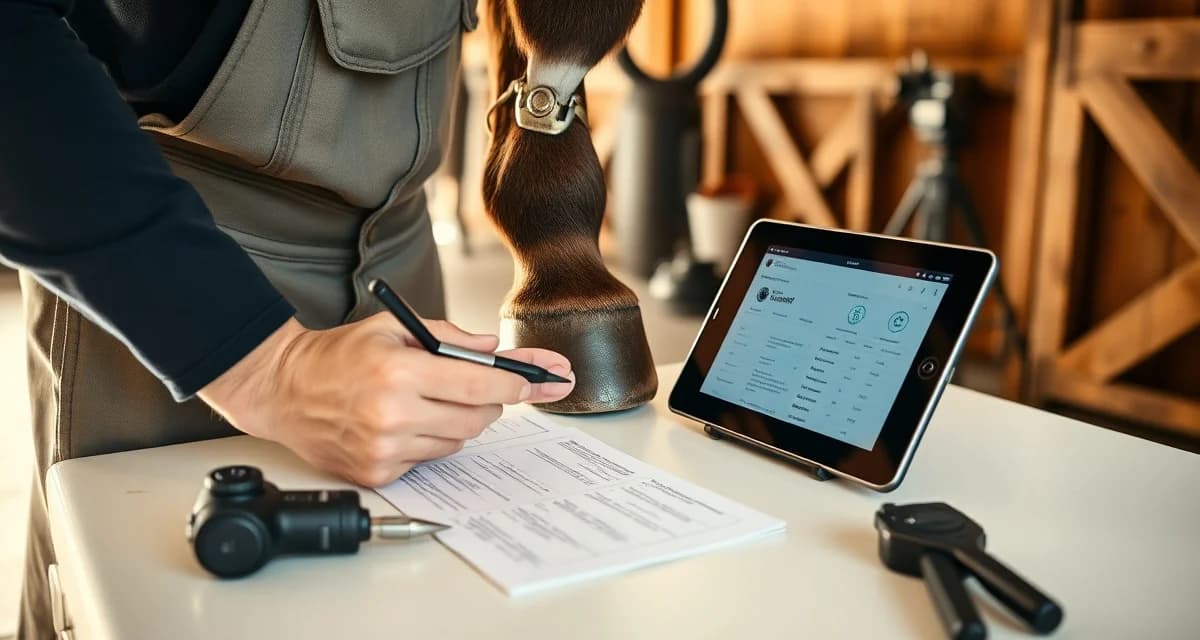
Hoof Health Records Software for Farriers: Full History Per Horse
Farriers who maintain detailed records are 3x more likely to retain clients long-term. That statistic reflects something real: horse owners who can see documented visit histories, condition notes, and photo progressions trust their farrier differently than those who get a verbal summary and a handwritten receipt.
Hoof health records software gives you that documentation without the administrative overhead of paper files. Every visit builds on the last. Every horse in your book has a complete, accessible history. And when a vet asks what you've been doing with a horse, you have the answer in your pocket.
TL;DR
- Farriers who maintain detailed records are 3x more likely to retain clients long-term -- documented visit histories and photo progressions create a fundamentally different level of client trust than verbal summaries and handwritten receipts.
- Incomplete horse records appear in 41% of farrier liability disputes; a timestamped record with photos, condition notes, shoe specifications, and communication history is far more defensible than memory.
- Vets report that 65% of farrier cases they see lack adequate treatment documentation -- sharing a horse's hoof history before a vet examination positions you as a collaborative partner and improves care coordination.
- A single visit record tells you what you saw that day; a complete history across 10-15 visits tells you whether a horse is improving, declining, or holding steady -- that trend is what catches problems before they become lameness events.
- Photo-linked records allow direct visual comparison of hoof condition across visits, particularly for laminitis, white line disease, and corrective shoeing cases where visible progress matters for treatment decisions and client confidence.
- For a book of 100 horses, full baseline coverage develops within 3-4 months of regular use -- within two or three shoeing cycles per horse, you have enough history to start seeing patterns.
- FarrierIQ stores records indefinitely; inactive horses can be archived rather than deleted, keeping their history available for horses that change ownership, return to your book, or become subject to insurance or legal proceedings.
What Hoof Health Records Should Capture
A useful horse hoof record isn't just a date and a service type. The records that actually help you - and protect you - capture specifics at every visit.
Every Visit Record Should Include
- Date of service
- Service type (trim, reset, new set, therapeutic, corrective)
- Shoe type and size
- Nail pattern and size
- Hoof condition rating per foot with specific observations
- Any abnormalities: thrush, white line, bruising, cracking, flare, contracted heels
- Products applied: hoof packing, pine tar, medication
- Photos of each hoof
- Vet coordination notes if applicable
FarrierIQ structures all of this in a per-horse format. Every field is accessible from your phone at the barn, with or without cell signal.
Tracking Condition Trends Over Time
A single visit record tells you what you saw that day. A complete history across 10 or 15 visits tells you whether a horse is improving, declining, or holding steady. That trend is what lets you catch problems before they become lameness events.
FarrierIQ displays condition history as a timeline per horse. You can compare hoof wall quality across visits, see whether thrush has been recurring, and track changes in growth rate. Photo-linked records let you compare hoof condition across visits visually - the kind of comparison that's nearly impossible with paper notes.
Why Records Protect You
Incomplete horse records appear in 41% of farrier liability disputes. When a horse owner claims you caused an injury or failed to follow a vet's therapeutic protocol, your defense is your documentation.
A timestamped record with photos, condition notes, shoe specifications, and client communication history is far more defensible than memory or a sticky note. The detail matters.
Beyond liability, documentation builds client trust. When you show a horse owner a complete history of every service performed - with photos tracking the progressive improvement in a horse with contracted heels - that's not just professional. It's the kind of thing that generates referrals.
See farrier client management for how hoof health records fit into the broader owner relationship structure.
Photo Documentation: The Feature That Changes Everything
A photo taken at each visit does something text notes can't: it shows the hoof as it was, at that moment, without interpretation.
Side-by-side comparison photos tied to visit dates show healing progress clearly. For horses in therapeutic care - laminitis, white line disease, corrective shoeing - this visual record is often more convincing to horse owners than written descriptions. You can show rather than tell.
FarrierIQ lets you attach photos to each visit in the horse's permanent record. They're stored alongside the clinical notes and accessible at every subsequent visit.
Per-Horse Records for Every Type of Client
Different horses need different record structures. A Thoroughbred in active show prep has different documentation needs than an Amish draft horse on a farm route.
FarrierIQ's per-horse customizable records let you capture what matters for each animal. Custom fields, health condition flags, vet notes, and specialized shoeing details can all be added without being forced into a generic template.
For horses with ongoing conditions - laminitis, navicular syndrome, white line disease - condition-specific fields help you track the right data at every visit.
Sharing Records With Vets and Trainers
Vets report that 65% of farrier cases they see lack adequate treatment documentation. That gap has real consequences for coordinated care.
FarrierIQ's shareable record links let you send a vet-readable summary of a horse's recent farrier visits without requiring the vet to access the app. Before a vet examination, you can share the horse's hoof history, shoeing details, and clinical observations so the vet walks in with context.
This kind of responsiveness is uncommon and valued. It positions you as a collaborative partner rather than a standalone service provider.
See the hoof cycle tracking guide for how health records connect to your interval tracking and scheduling system.
How Long Should You Keep Hoof Health Records?
There's no universal legal requirement for farrier record retention, but best practices from the equine industry suggest keeping records for at least the duration of your relationship with the client, plus three years after the last visit.
For horses in therapeutic care - laminitis, navicular, corrective shoeing - longer retention makes sense. A horse that had a laminitic episode three years ago may be entirely recovered, but the historical record could matter if a related issue develops later.
FarrierIQ stores records indefinitely. Inactive horses can be archived rather than deleted, keeping their history available without cluttering your active client view.
Getting Started With Hoof Health Records
On your first few visits using a digital record system, you'll build baseline records for each horse. Enter what you know: recent shoe type, any known conditions, approximate condition rating.
Within two or three shoeing cycles per horse, you have enough history to start seeing patterns. For a book of 100 horses, that's full baseline coverage in about three to four months of regular use.
The documentation habit pays off early. Horse owners notice when their farrier pulls up a complete visit history at the start of the appointment. That kind of preparation - and the trust it builds - is one of the most effective retention tools available.
Related Articles
FAQ
What should be in a horse hoof health record?
A complete horse hoof health record should include the date of each visit, service type, shoe type and size, nail pattern, hoof condition rating for each foot, any abnormalities observed, products applied, photos, and vet coordination notes if applicable. The horse's breed, age, discipline, and standing treatment protocols are also valuable context fields. FarrierIQ structures all of this in a per-horse profile linked to your invoices and scheduling records.
Can I attach photos to horse records in farrier software?
Yes. FarrierIQ supports photo attachments in every visit record. Photos are tied to the specific visit date and accessible in the horse's full history. This allows direct visual comparison of hoof condition across visits - particularly useful for horses in therapeutic care where tracking visible progress or deterioration matters for treatment decisions.
How long should I keep hoof health records?
Keep records for at least the duration of your client relationship plus three years after the last visit. For horses in therapeutic or corrective care, longer retention is advisable. FarrierIQ archives inactive horses so their complete history remains available without cluttering your active client view.
What's the most efficient way to capture hoof condition notes in the field?
Voice-to-notes is the fastest method when your hands are dirty or you're working in difficult conditions. Speaking a 15-20 second note while you're still looking at the foot -- "left front, mild thrush returning in central sulcus, treated, third consecutive visit with this" -- creates a complete dated record without stopping to write. FarrierIQ's voice-to-notes feature records directly to the horse's visit record with a timestamp. For visits where conditions are unremarkable, a brief condition rating check takes under a minute and still establishes the baseline that makes future comparisons meaningful.
How do you handle hoof health documentation when you're coordinating with a vet on a therapeutic case?
Document the vet's recommendations and any coordination conversations as part of the horse's record, not just your own observations. "Vet Dr. Callahan recommended egg bar with 3-degree wedge, radiographs confirmed 5-degree rotation" ties your shoeing decisions to the clinical basis for them. Before each farrier visit on a therapeutic case, review the vet's protocol and note any deviations or concerns in your record. When the vet follows up, you can share the horse's farrier visit history directly from FarrierIQ so they can see exactly what was done and when -- that coordination closes the communication gap that appears in most farrier-vet cases.
Sources
- American Farrier's Association (AFA), professional documentation standards and record retention guidance
- American Association of Equine Practitioners (AAEP), farrier-veterinarian coordination and treatment documentation best practices
- American Farriers Journal, digital records adoption and clinical documentation for working farriers
- Professional Farrier Magazine, hoof health tracking and liability documentation case studies
Get Started with FarrierIQ
The 3x client retention advantage for farriers with detailed records comes directly from the trust that documentation builds -- owners who can see their horse's complete hoof history and photo progression stay with the farrier who shows that level of professionalism. FarrierIQ's hoof health records system captures every visit in a format that protects you professionally and improves outcomes for the horses you serve. Try FarrierIQ free and build your first complete horse records in the first week.