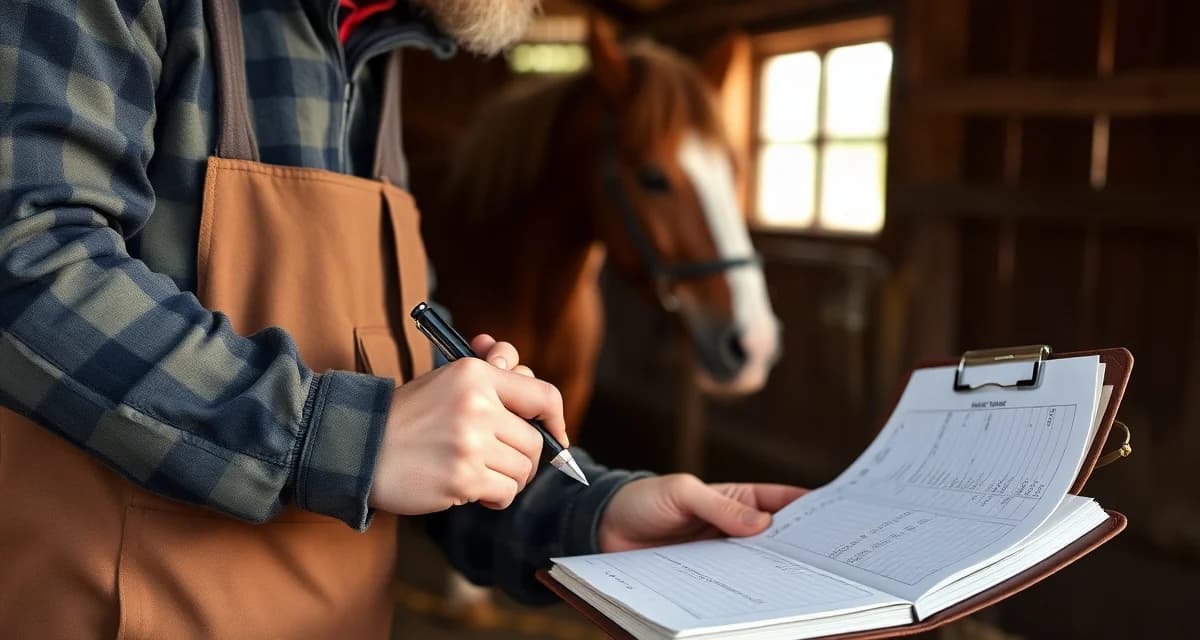
How to Keep Horse Shoeing Records: What to Track and How to Store It
Incomplete horse records show up in 41% of farrier liability disputes. When a horse owner claims you damaged their horse, or that you didn't follow the vet's therapeutic protocol, your documentation is your defense. Or your liability, if it's missing.
TL;DR
- Incomplete records appear in 41% of farrier liability disputes, making documentation your primary legal protection.
- Every visit record should capture shoe type, size, nail pattern, and a per-foot hoof condition rating - not just the service performed.
- Farriers with organized records retain clients 34% longer on average than those without structured documentation.
- Records should be organized by horse profile, not by date, so you can pull up any horse's full history in seconds.
- Active client records should be kept indefinitely; records tied to injuries or disputes should be retained for at least 5-7 years.
- Voice-to-notes tools let you dictate condition observations in about 20 seconds while still at the horse, before details blur.
- Photos tied to each visit are the single most valuable piece of documentation in a liability situation or client progress conversation.
Record-keeping isn't about bureaucracy. It's about protecting yourself, catching health trends early, and building the kind of professional reputation that generates referrals. This guide covers what to track, how to track it, and how digital tools make the process fast enough to actually sustain.
Why Farrier Records Matter More Than You Think
Liability protection: A timestamped record of what you did, what condition you observed, and what shoe type you applied is documentation that stands up. A memory doesn't. In 41% of disputes, the absence of records determines the outcome.
Early health detection: Shoeing history tied to AI health flagging creates an early warning system per horse. Trends in hoof wall quality, recurring thrush, changes in growth rate - these patterns emerge in records before they're visible in a single visit.
Client retention: Farriers with organized records retain clients 34% longer on average. Clients who can access their horse's full history feel like they're in professional hands. Those who call you and hear "uh, let me think… I think it was aluminum?" feel differently.
Step 1: Know What Records to Keep per Visit
Every visit record should include:
Administrative information:
- Date of service
- Horse owner name
- Horse name, breed, age, and discipline
- Service performed (trim, reset, new set, corrective, therapeutic)
Shoe and nail specifications:
- Shoe type (steel, aluminum, rubber, composite, therapeutic)
- Shoe size (00 through 6+, or draft sizing)
- Nail size and pattern per foot
- Any pads used (plain, frog, wedge, silicone)
- Any modifications to the shoe (extensions, trailers, toe clips, rim removal)
Hoof condition per foot:
- Condition rating (scale of 1-5 or simple good/fair/poor)
- Wall quality: thick, thin, cracked, flared, shelly
- Sole condition: chalky, thin, bruised
- Frog condition: atrophied, thrush, healthy
- Heel condition: contracted, underslung, healthy
- Any specific concerns (white line separation, abscess site, seedy toe, etc.)
Additional notes:
- Any vet instructions you're following
- Owner observations about the horse's behavior or gait
- Your recommendations for next visit
- Anything you noticed that the owner should know
Step 2: Capture Records at the Horse, Not at Home
The biggest failure in record-keeping is delaying the entry. By the time you get home, the details blur. You remember the big things - the laminitic horse, the one who kicked - but you've lost the granular condition notes that make records actually useful.
FarrierIQ's voice-to-notes feature lets you dictate your condition notes out loud while you're still at the horse. Thirty seconds of narration captures more accurate detail than 10 minutes of evening reconstruction.
"Left front: slight flare developing on the medial wall, Grade 2 condition, thin sole, clean frog. Applied steel size 2, 7s nail pattern. Recommended heel supplement at next owner contact."
That's a voice note. It takes 20 seconds. It's in the record, timestamped, accurate.
Step 3: Take Photos
Photos are worth more than any written description in a dispute. They're also tremendously useful for showing clients progression over time - a contracted heel that's opened up over four visits, a horse recovering from a white line event.
FarrierIQ stores unlimited photos tied to each visit. Take all four hooves before and after when time allows. At minimum, photograph anything unusual.
Step 4: Organize by Horse, Not by Date
Records organized by date ("shoeing log for February") are nearly useless when you need to look up a specific horse. Records organized by horse - each horse has its own profile with complete history - let you pull up exactly what you need in seconds.
FarrierIQ's per-horse profile structure automatically organizes everything this way. When you need to know what shoes Bella had on last visit, you open Bella's profile. You're not scrolling through a chronological log looking for her name.
Step 5: Retain Records Long Enough
There's no universally mandated retention period for farrier records (unlike medical records, which have statutory requirements). But practical guidance:
- Keep active client records indefinitely while the relationship is ongoing
- After a client relationship ends, retain records for at least 3-5 years
- If there was any injury, dispute, or documented health concern, retain those records longer (5-7 years minimum)
With FarrierIQ syncing to cloud storage for farrier records, record retention is automatic. You're not managing paper storage or worrying about a hard drive failing.
Common Record-Keeping Mistakes
Not recording shoe specifications consistently: "Did the usual" doesn't help you next visit. Write the shoe type and size every time.
Skipping the condition notes: The service you performed is the invoice. The condition you observed is the record. Both matter. Don't confuse them.
No photos on corrective or therapeutic cases: These are the exact horses where visual documentation matters most.
Paper records that get wet, torn, or lost: A barn is not a good archive environment. If you're still on paper, you're losing records regularly whether you know it or not.
Related Articles
FAQ
What records should a farrier keep for each horse?
Every horse's record should include the date of each visit, service performed, shoe type and size, nail pattern, hoof condition rating for each foot, photos, products applied, and any health observations or vet-instructed protocols being followed. Farriers who capture all of this per visit have clear documentation for liability situations, can track health trends over time, and can answer client questions immediately rather than guessing.
How long should farriers keep shoeing records?
Active client records should be maintained indefinitely. After a client relationship ends, a minimum of 3-5 years is prudent. Records involving any injury, dispute, lameness concern, or therapeutic protocol should be kept for 5-7 years or longer. With digital tools like FarrierIQ that sync to cloud storage, long-term retention has no practical cost - it's automatic.
Are farriers legally required to keep records?
Most states don't mandate specific record-keeping requirements for farriers. But liability exposure is significant. Incomplete records appear in 41% of farrier liability disputes, and the outcome of those disputes often depends on what documentation exists. From a professional standpoint, comprehensive records are essential - not because the law requires them, but because the alternative is trying to defend your work from memory against someone who might be recording their own account of events.
Should farriers share records with horse owners or veterinarians?
Sharing records with horse owners builds trust and supports the professional relationship. When a vet is involved in a therapeutic or corrective case, sharing your shoeing notes and photos directly with them helps coordinate care and reduces the chance of conflicting protocols. FarrierIQ lets you export a horse's full visit history as a PDF, which makes sharing with vets or new owners straightforward without giving anyone access to your full client database.
What should a farrier do if a horse changes owners mid-treatment?
If a horse is mid-treatment for a corrective or therapeutic issue and changes owners, the shoeing record becomes especially important. Document the current shoe setup, the condition being addressed, and any vet instructions in writing before the transition. Providing the new owner with a summary of the horse's recent hoof history protects you from being blamed for pre-existing conditions and gives the incoming owner a clear starting point.
How do farrier records help when working with a veterinarian on a laminitis or navicular case?
In cases involving laminitis, navicular syndrome, or other diagnosed conditions, the vet is often directing the therapeutic protocol and the farrier is executing it. Detailed records showing exactly what shoe, pad, and angle adjustments were made at each visit create a clear paper trail that the vet can review. If the horse's condition changes, those records help both professionals identify whether the shoeing approach needs adjustment or whether the issue lies elsewhere.
Sources
- American Farriers Journal, Lessiter Media
- American Association of Equine Practitioners (AAEP)
- University of Minnesota Extension, Equine Program
- Guild of Professional Farriers (GPF)
- The Farriers' Registration Council (FRC), United Kingdom
Get Started with FarrierIQ
FarrierIQ gives you per-horse profiles, voice-to-notes capture, photo storage, and automatic cloud backup - everything covered in this guide, built into one tool designed for working farriers. If incomplete records are a liability risk you'd rather not carry, try FarrierIQ free and see how fast documentation can become part of your normal workflow at the horse.