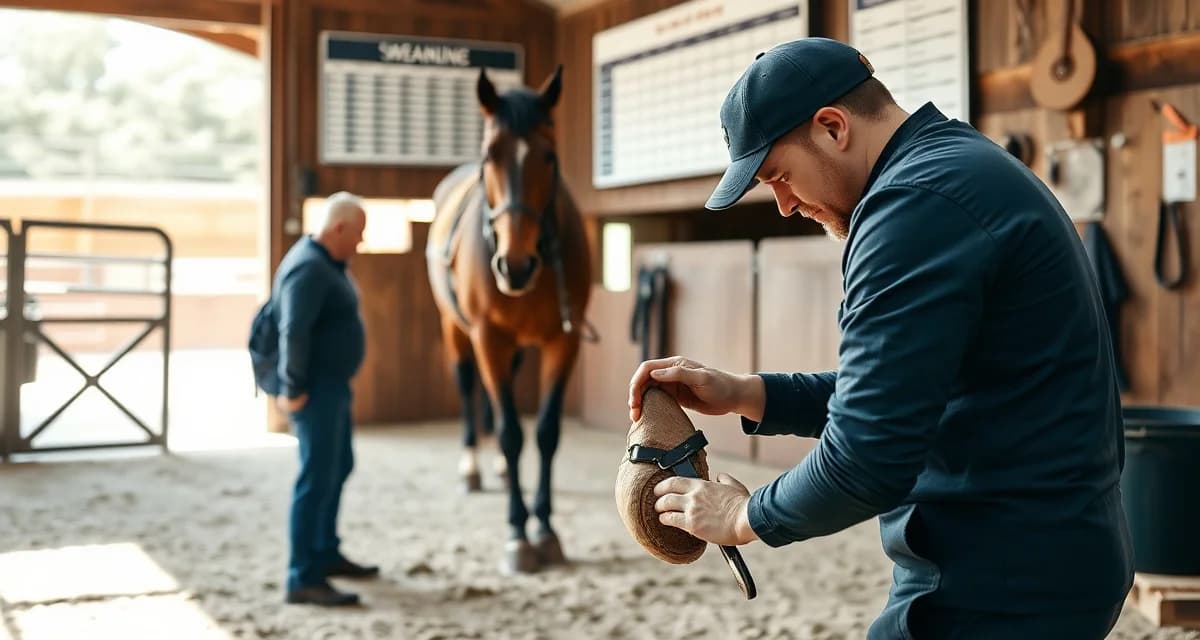
Managing the Wellington Show Season: How a South Florida Farrier Uses FarrierIQ
The Winter Equestrian Festival at Wellington runs for 12 consecutive weeks from January through April. It's the most demanding stretch of the show jumping calendar in North America, and for a farrier serving the circuit, it's 12 weeks of emergency calls, schedule changes, pre-class shoeing windows, and horse owners who need something done yesterday.
During Wellington show season this farrier fielded 18+ emergency shoe calls per week. Managing 220 horses through WEF without a sophisticated operational system isn't possible for one person -- not without burning out somewhere in February.
Elena is on her seventh year of covering the Wellington circuit. She doesn't burn out anymore.
TL;DR
- WEF runs 12 consecutive weeks January through April -- 220 horses within 15 minutes of each other, every horse with specific shoeing requirements, pre-class windows as tight as 10 days, and 18+ emergency calls per week at peak; memory doesn't scale to this.
- Elena's November outreach collects every client's WEF show schedule before the circuit starts; by December 15, all show dates and required shoeing windows are in FarrierIQ, and she enters the circuit with 80%+ of her schedule already structured.
- Emergency slots are blocked as reserved capacity, not filled with scheduled horses -- because emergency volume during WEF is predictably high even if timing is unpredictable, the capacity exists before the calls come in rather than requiring cancellation of scheduled work.
- The horse owner portal eliminates the "when are you coming?" call volume that would otherwise be continuous across 220 owners and trainers; automated 48-hour reminders handle routine confirmation without manual effort.
- Records with specific shoeing specifications per horse are essential at the premium show level -- getting details wrong on a Grand Prix horse with a specific shoe modification is a different category of mistake than getting it wrong on a trail horse.
- Post-season, records travel with Elena when clients ask her to follow horses to summer venues -- the same history is accessible at Spruce Meadows or Kentucky as it was at Palm Beach International Equestrian Center.
What Makes Wellington Unique for Farriers
WEF isn't like managing a regular horse book with a seasonal spike. It's a different category of work:
Concentration: 220 horses within a 15-minute radius for 12 weeks. The routing efficiency gains that matter most in normal farrier work are less relevant here -- everything is close. The premium instead is on schedule management and emergency response.
Complexity: Every horse on the circuit has specific shoeing requirements, specific pre-class windows (fresh shoes within 10 days of major classes, sometimes tighter for upper-level horses), and owners or trainers with high professional standards and specific preferences. Memory doesn't scale to 220 horses' individual requirements.
Demand volatility: A shoe that's perfectly sound on Monday morning may pull off on Thursday at morning warm-up. Emergency calls during WEF come in patterns -- bad weather days create more footing-related issues; big show days create more pre-class urgency. Elena fields 18+ emergency calls per week during peak WEF weeks.
Communication volume: 220 horses means 220 owners or trainers who might need communication about their horse's feet at any time. Without a system that handles routine communication automatically, a farrier is spending hours per day on status calls and appointment confirmations.
The Scheduling Infrastructure Elena Built
Elena runs FarrierIQ's scheduling tools with specific configurations for WEF:
Pre-season build: By December 15, every Wellington client's show schedule is entered into FarrierIQ. Show dates, class dates, required shoeing windows -- all of it is in the system before the circuit starts. She contacts clients proactively in November to collect their WEF schedule, using the same template every year.
Emergency call protocol: Her emergency slots are blocked on specific days as reserved capacity -- not filled with scheduled horses, but available for the shoe-loss and pre-class emergency calls that are predictable in volume even if not in timing. This means she doesn't have to cancel scheduled appointments to handle emergencies; she absorbs them into pre-planned capacity.
Automated reminders handle the routine: Every scheduled appointment gets an automated 48-hour confirmation request. She doesn't manually confirm 220 horses' worth of appointments. The system handles routine communication; she handles clinical work and the complex cases.
Real-time schedule display through the horse owner portal: Clients can see their horse's appointment status, upcoming visits, and recent work through the FarrierIQ horse owner portal. This eliminates the "when are you coming?" calls that would otherwise be continuous during WEF weeks.
Handling the Emergency Volume
Eighteen-plus emergency calls per week during a busy WEF week is a significant volume. Elena's approach:
Triage by urgency and class schedule: Not all emergencies are equal. A horse that lost a shoe the morning of its class is a different priority from one that lost a shoe the night before an off day. Her scheduling app lets her see each horse's class schedule and prioritize accordingly.
Emergency rate: Elena charges a premium for same-day emergency work that isn't in the regular pre-class window. This reduces the volume of non-urgent calls framed as emergencies and compensates appropriately for the schedule disruption of genuine urgent cases.
Cluster emergencies geographically: Wellington's compact geography means that multiple emergencies in the same hour can sometimes be grouped. If she's already going to Barn A for an emergency, she checks FarrierIQ to see if any neighboring barns have pre-class needs she can address in the same trip.
Records at Show Scale
At 220 horses over 12 weeks, the records component is critical. Every horse has specific shoe specifications -- the Grand Prix horses don't get standard front shoes, they get the exact shoe type and modification their trainer has specified. Getting the details wrong on a $200,000 show horse matters in a way it doesn't for a trail horse.
FarrierIQ's hoof health records mean the specifications are on her phone before she opens a stall door. She's not relying on memory for 220 horses' individual requirements.
Post-Season Transition
When WEF ends in late March, Elena's Wellington client book largely disperses to summer competition venues. She maintains records on every horse through the off-season so that when the same horses return in January, the two-year history is immediately accessible.
Some clients ask her to follow their horses to summer competitions -- Spruce Meadows, Kentucky, HITS-on-the-Hudson. The records travel with her in FarrierIQ regardless of geography.
Frequently Asked Questions
How do farriers handle Wellington's show season?
Managing Wellington requires pre-season scheduling (entering show calendars in November before WEF starts), reserved emergency capacity in the weekly schedule, automated communication for routine appointment management, and organized horse records with specific shoeing requirements for each horse. Without a scheduling system that handles the routine communication automatically, a Wellington farrier spends hours per day on status calls that the horse owner portal and automated reminders handle automatically. FarrierIQ's scheduling infrastructure is used by several farriers serving the WEF circuit.
What tools help farriers manage a Florida winter circuit horse book?
The combination of an organized scheduling system with pre-season booking capability, emergency call protocols, automated reminders, and a horse owner portal for client self-service covers the key management challenges of a Florida show circuit book. Horse records with specific shoeing requirements stored per horse are essential at the premium show level where getting details wrong on a high-value competition horse has real consequences. FarrierIQ's integrated platform handles all of these functions without requiring multiple separate apps.
How do you handle 220 horses during show season as a solo farrier?
The honest answer is that you can't handle it without good systems. Pre-season scheduling builds the schedule before the intensity hits, so you enter the circuit with a structured plan rather than building it reactively week by week. Reserved emergency capacity absorbs the predictably high emergency volume without disrupting scheduled appointments. Automated communication handles the routine interactions so you're not personally confirming every appointment for 220 horses. Records organization means you arrive at each horse prepared rather than trying to remember 220 sets of individual specifications. The systems do what one human brain can't.
How do you manage a client who wants to change their horse's shoe specification mid-season?
Get it in writing before you make the change -- a text or email confirmation is sufficient -- and log the new specification immediately in FarrierIQ with the date and who authorized it. During a high-stakes circuit like WEF, trainers and owners sometimes have conflicting opinions about what a horse should be in, and you can find yourself receiving instructions from a trainer that contradict what the owner last told you. The record showing who authorized what and when protects you from becoming the point of dispute. If instructions are genuinely in conflict, ask the owner or trainer to align before you proceed -- the few minutes it takes to get clarity is worth far more than the conversation you'd need to have after putting the wrong shoe on a $200,000 horse.
What's the approach for handling a client whose horse needs work but their trainer is saying to wait?
Document both positions in FarrierIQ with dates: what you observed, what you recommended, what the trainer said, and what the owner decided. At the premium show level, deferred care decisions sometimes result in soundness issues that come back as disputes over who should have acted sooner. Your record of recommending the work and noting that the trainer directed otherwise is your professional protection. Follow up with the owner directly if the trainer's position creates what you believe is a genuine hoof health risk -- send a brief written note documenting your concern. Most clients appreciate that level of proactivity; they don't want to discover a developing problem on class day.
Sources
- US Equestrian Federation (USEF), Wellington competition calendar and Winter Equestrian Festival information
- American Farrier's Association (AFA), show farrier operations and premium circuit management resources
- American Association of Equine Practitioners (AAEP), competition horse hoof care and shoeing standards
- Professional Farrier Magazine, Wellington and Florida winter circuit farrier operations
Get Started with FarrierIQ
Elena's seventh WEF runs smoothly because the infrastructure is built before January arrives: schedule in the system by December 15, emergency capacity reserved, reminders automated, records loaded with each horse's specifications. The 12-week intensity is the same every year; what changed is having a system that absorbs it instead of one person trying to hold it all in their head. FarrierIQ's scheduling tools and hoof health records are the foundation that makes show season manageable. Try FarrierIQ free before your next competition season starts.