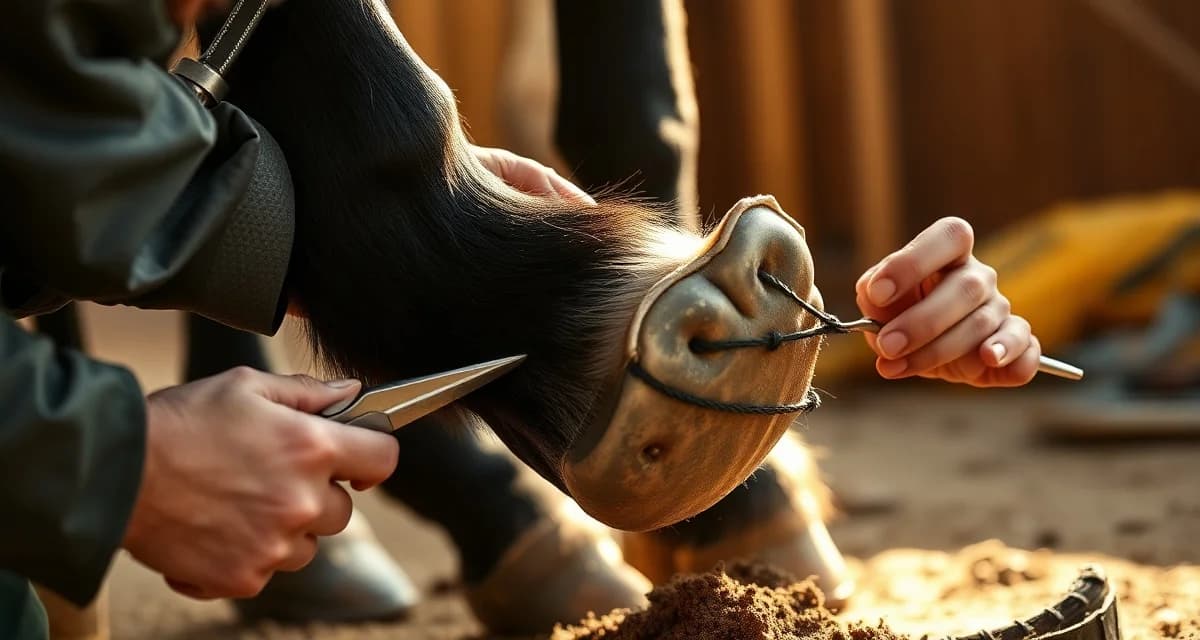
Friesian Farrier Care: Black Beauties With Specific Hoof Needs
Friesians have naturally fast hoof wall growth, often requiring trimming every 4-5 weeks. That faster-than-average growth rate, combined with the breed's well-documented tendency toward white line disease and other hoof conditions, makes consistent farrier care more important for Friesians than for most other breeds.
TL;DR
- Friesians have the highest lifetime incidence rate of white line disease of any breed at approximately 62% -- the heavy feathering traps moisture and organic material against the hoof wall, creating the conditions for infection in the non-living horn material.
- Friesians need farrier visits every 4-5 weeks due to faster-than-average hoof wall growth -- the 6-8 week standard for other breeds is too long, and Friesians in active dressage training particularly suffer from the angle changes that accumulate over a longer cycle.
- Feathering management is a client conversation worth having -- moderate thinning around the coronary band (not full removal) allows better drainage, air circulation, and visual inspection access; Friesians managed with lighter feathering at the hoof capsule have meaningfully lower hoof condition rates.
- White line disease in Friesians is far more effectively managed with early detection than late treatment -- systematic monitoring at every visit, with condition tracking in the records, catches early white line before it becomes an established case.
- Friesian owners are typically attentive and research-oriented about their breed -- arriving prepared with knowledge of white line disease, CPL, and feathering challenges positions you as the farrier who understands the breed rather than one who treats a Friesian like any other black horse.
- FarrierIQ's farrier scheduling software sets Friesian clients on the shorter 4-5 week default interval automatically with reminders that prevent the deferred scheduling pattern that leads to white line disease cases.
- Proactive communication -- white line condition notes, feathering management recommendations, clear hoof records -- builds the long-term client trust that makes Friesian owners stay with one farrier rather than switching.
The Friesian is a rising star in the North American horse market. Their dramatic appearance and naturally elevated action have made them popular in dressage, in recreational riding, and in the media. For farriers, a Friesian client is a high-engagement account that rewards careful attention to detail.
The Friesian is a rising star in the North American horse market. Their dramatic appearance and naturally elevated action have made them popular in dressage, in recreational riding, and in the media. For farriers, a Friesian client is a high-engagement account that rewards careful attention to detail.
The White Line Disease Problem
Friesians have the highest lifetime incidence rate of white line disease of any breed at approximately 62%. This is well-established in veterinary literature and is the first thing any farrier working with Friesians needs to understand.
White line disease, also called seedy toe or onychomycosis, is an infection of the non-living horn material in the white line zone between the hoof wall and sole. It creates pockets, often packed with crumbling, powdery material, that can undermine the hoof wall over time. In mild cases, it's a straightforward management issue. In advanced cases, it can severely compromise hoof integrity and require notable remediation.
Friesians are prone to white line disease because of a combination of factors:
- The heavy feathering on their lower legs traps moisture and organic material against the hoof wall.
- The breed's broad, flat-soled hooves have less natural concavity for drainage.
- Genetic factors related to their hoof horn quality.
Prevention is far preferable to treatment. FarrierIQ's hoof health records support systematic white line monitoring at every visit, with condition notes that track any white line issues over time. Catching early white line at visit three and noting its progression or resolution at visit four is the practical application of FarrierIQ's longitudinal record system.
Feathering: Beautiful and Problematic
The Friesian's abundant feathering is one of the breed's signature visual features and a source of genuine hoof management challenge. Heavy, wet feathering presses against the hoof wall and coronary band, creating an environment where:
- Moisture stays against the hoof wall longer after rain or wet conditions
- Organic material accumulates in the feathering and sits against the hoof
- Mud fever and skin conditions affect the lower leg, sometimes extending to the coronary band area
Working with Friesian owners on feather management is part of the farrier conversation. Most Friesian owners are reluctant to trim the feathering considerably, and that's understandable. The feathering is part of the breed's identity. But discussing moderate management of the feathering around the coronary band, allowing better drainage and access to the hoof wall for visual inspection and air circulation, is a worthwhile conversation.
Hoof Growth Rate and Visit Intervals
Friesians grow hoof wall faster than most light horse breeds. The 4-5 week interval that many Friesian owners need reflects this biological reality, not excessive caution. A Friesian allowed to go 8 weeks between trims will often show more overgrowth and angle change than a Quarter Horse at the same interval.
For Friesians in active dressage training, the precision required for collection work makes the shorter interval even more important. Hoof angle changes that accumulate across a long cycle affect the horse's movement in ways that show up clearly in collection work.
FarrierIQ's scheduling software sets Friesian clients on a shorter default interval, with automated reminders that prompt clients to keep appointments rather than deferring. Friesian owners who have experienced white line disease or other hoof issues are usually very motivated to maintain consistent scheduling once they understand the stakes.
Dressage Friesians
The majority of Friesians ridden in North America are used for dressage, either in traditional Friesian dressage (FPS keuring tests) or in USDF dressage competition. Shoeing considerations for Friesian dressage horses mirror those for other dressage breeds in terms of the angle, breakover, and shoe weight decisions that affect movement quality.
The Friesian-specific overlay is the white line monitoring and feathering management context that applies to every visit regardless of discipline.
Friesian Owner Expectations
Friesian owners tend to be invested and attentive. They've often done notable research about their breed's health characteristics. They appreciate a farrier who comes prepared with knowledge of the breed's specific challenges rather than treating a Friesian like any other black horse.
Being the farrier who proactively discusses white line disease management, provides clear records of hoof condition tracking, and communicates professionally after each visit builds the kind of trust that makes you the farrier for the long term with Friesian clients.
Frequently Asked Questions
How often do Friesian horses need a farrier?
Friesians typically need farrier visits every 4-5 weeks due to their naturally fast hoof wall growth rate. This is shorter than the 6-8 week standard for many other breeds. Friesians in active dressage training particularly benefit from the shorter interval because precise shoeing specifications degrade more quickly with their faster growth. Even Friesians in lighter work generally shouldn't go past 6 weeks.
What are the special hoof care needs of a Friesian?
White line disease monitoring is the most important ongoing concern, with the breed's 62% lifetime incidence rate reflecting how common the condition is. The heavy feathering management conversation with owners is also important for preventing the moisture and organic material accumulation that contributes to hoof conditions. The faster hoof growth rate requires more frequent visits than most other breeds.
Can farrier software track Friesian's longer hoof intervals?
The goal is actually the opposite, tracking Friesians on shorter intervals than the default. FarrierIQ allows you to set shorter intervals for breeds like Friesians that need more frequent attention. You can set a 4-5 week default for Friesian clients rather than the 6-8 week default appropriate for other breeds. The system tracks each Friesian independently and sends appropriate reminders on that shorter schedule.
How should a farrier handle a Friesian client who wants to extend the interval to every 6-8 weeks to reduce cost?
Acknowledge the cost concern, then explain the specific risk for this breed. Friesians have a 62% lifetime white line disease incidence -- and the feathering-moisture-growth combination means that risk is actively elevated when monitoring intervals lengthen. A practical response: "For most horses I work with, 6-8 weeks is fine. Friesians are different -- their hoof grows faster and the conditions under the feathering favor white line disease. I've seen Friesian cases where two extra weeks made the difference between catching early white line and treating an established case. I'd rather keep you on a 5-week schedule and keep this horse's feet healthy." Document the discussion in the visit record with the client's decision. If the client extends the interval over your recommendation and white line disease develops, your record shows you advised otherwise.
What should a farrier watch for at a Friesian appointment that they wouldn't check on most other breeds?
In addition to standard hoof assessment: part the feathering to access the coronary band and inspect for mud fever (pastern dermatitis), mite infestation signs (scaling, thickened skin, irritation), and early chronic progressive lymphedema indicators (firm, enlarged lower leg tissue that feels different from simple swelling). Check the heel bulbs for moisture damage and skin breakdown. Inspect the white line systematically around the full perimeter, not just the toe and quarters where packing is most visible. Note the feathering condition itself -- very heavy, matted feathering indicates the owner isn't managing it between visits. These additional checks add 3-5 minutes to the appointment and generate the hoof health records that demonstrate genuine breed-specific expertise to Friesian owners.
Sources
- American Association of Equine Practitioners (AAEP), Friesian breed health and hoof care guidelines
- American Farrier's Association (AFA), breed-specific farrier care resources
- University of Utrecht Faculty of Veterinary Medicine, Friesian horse breed-specific health research including CPL and white line disease prevalence
- Friesian Horse Association of North America (FHANA), breed management and health resources
Get Started with FarrierIQ
Friesians need 4-5 week intervals and systematic white line monitoring at every visit -- FarrierIQ's farrier scheduling software sets the shorter default interval automatically, and the hoof health records track white line condition across visits so early progression doesn't get missed. Try FarrierIQ free and set up your first Friesian client on their breed-appropriate interval today.