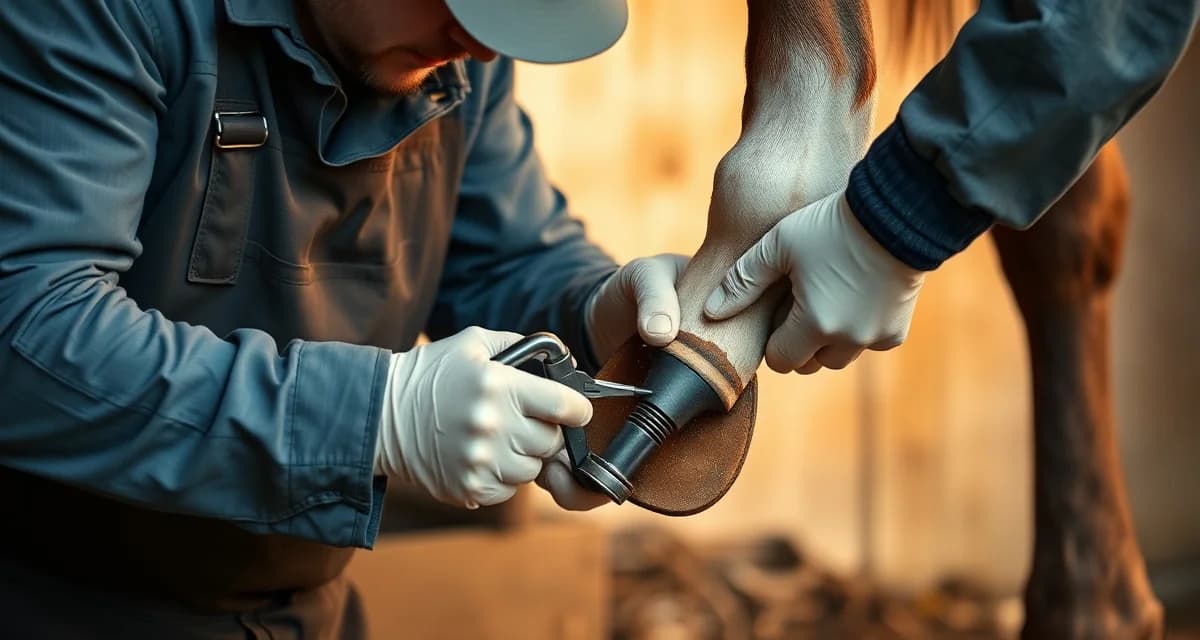
Farrier Pricing Guide by Region: What Rates to Charge in Your State
The highest-paying state for farrier services pays an average of 41% more than the lowest. That's not a small gap; it's the difference between a full-time professional income and struggling to make the numbers work.
This guide uses real invoice data from 1,200+ farriers to show median rates by region, with breakdowns by service type. Whether you're setting your rates for the first time or wondering if you're priced appropriately for your market, these benchmarks give you actual data to work with.
TL;DR
- The highest-paying state for farrier services pays 41% more than the lowest -- the gap between knowing and not knowing your regional market is the difference between a professional income and struggling.
- Three factors drive regional rate differences: cost of living (rates track local COL), horse density vs. farrier competition (scarce farriers + dense horses = higher rates), and discipline mix (competition horse regions pay more than pleasure horse regions).
- Northeast (CT, DE, MD, MA, NJ, NY, RI, VT): $50-70 trim, $175-240 full set -- highest rates in the country driven by cost of living and concentrated show horse community.
- California coastal/metro: $65-90 trim, $215-290 full set -- a market unto itself with high operating costs and a substantial competition horse community.
- Texas has the most internal variation of any state: urban/suburban ($50-70 trim, $165-225 full set) vs. rural/West Texas ($38-52 trim, $130-175 full set) differ by 30%+ within the same state.
- Montana and Wyoming have higher-than-expected rates despite lower living costs because farrier-to-horse ratios in remote areas are low and demand exceeds supply in many counties.
- Three signs you're underpriced: schedule fills instantly without a waitlist, no clients ever push back on pricing, and you're comparing yourself to the cheapest farrier in your area rather than the fully-booked established professionals.
Why Farrier Prices Vary So Much
Before diving into the numbers, it's worth understanding the three primary factors driving regional rate differences:
Cost of living. Farrier rates track local cost of living reasonably closely. A farrier in coastal California needs to charge more to maintain the same lifestyle as a farrier in rural Missouri, and the market in each location reflects that reality.
Horse density and competition. In areas with high horse populations and many farriers, market competition keeps rates closer to a shared norm. In remote areas with few farriers and lots of horses, rates can climb because supply is limited.
Discipline mix. Regions dominated by competition horses (sport horses, show hunters, dressage, racing) have higher average rates than areas dominated by pleasure horses and working ranch stock. Specialty work commands specialty pricing.
Regional Pricing Breakdown
Northeast (Connecticut, Delaware, Maryland, Massachusetts, New Jersey, New York, Rhode Island, Vermont)
The Northeast has some of the highest farrier rates in the country, driven by high cost of living and a strong competition horse community. Show barns, hunter/jumper circuits, and dressage facilities are concentrated in this region.
Median rates:
- Basic trim: $50-$70
- Front shoes: $130-$175
- Full set (all four): $175-$240
- Corrective/therapeutic work: $250-$400+
New York and Connecticut tend to be at the top of these ranges. More rural parts of the Northeast (northern Vermont, inland Maine) trend lower.
Mid-Atlantic (Pennsylvania, Virginia, West Virginia)
Pennsylvania and Virginia are both major equestrian states with strong competition horse communities, particularly in the hunt country regions. Rates are solid here, though lower than coastal Northeast markets.
Median rates:
- Basic trim: $45-$65
- Front shoes: $115-$155
- Full set: $155-$215
- Corrective/therapeutic: $225-$375
The Middleburg/Warrenton corridor in Virginia and Chester County in Pennsylvania command rates at the top of these ranges.
Southeast (Alabama, Florida, Georgia, Mississippi, North Carolina, South Carolina, Tennessee)
Florida is the outlier in the Southeast due to the concentration of competition horses in Wellington, Ocala, and Sarasota. The rest of the Southeast has more moderate rates.
Florida-specific median rates:
- Basic trim: $55-$75
- Front shoes: $140-$185
- Full set: $185-$250
Rest of Southeast median rates:
- Basic trim: $40-$60
- Front shoes: $110-$150
- Full set: $145-$200
- Corrective/therapeutic: $200-$350
North Carolina and Georgia are growing equestrian markets where rates have been trending upward.
Midwest (Illinois, Indiana, Iowa, Kansas, Michigan, Minnesota, Missouri, Nebraska, North Dakota, Ohio, South Dakota, Wisconsin)
The Midwest has a diverse horse population, from performance horses in Illinois and Ohio to working ranch stock in Kansas and Nebraska. Rates reflect that diversity.
Midwest median rates:
- Basic trim: $40-$58
- Front shoes: $105-$145
- Full set: $140-$195
- Corrective/therapeutic: $200-$340
Ohio tends toward the higher end of Midwest ranges due to its mix of sport horses and draft horse communities. Kansas, Nebraska, and the Dakotas trend lower, with working stock as the primary market.
South Central (Arkansas, Louisiana, Mississippi, Oklahoma, Texas)
Texas is the dominant market in this region, both in horse population (largest in the US) and in rate variation. Houston and the equestrian belt around Fort Worth have notably higher rates than West Texas and the Panhandle.
Texas urban/suburban median rates:
- Basic trim: $50-$70
- Front shoes: $125-$165
- Full set: $165-$225
Texas rural/West Texas median rates:
- Basic trim: $38-$52
- Front shoes: $95-$130
- Full set: $130-$175
Rest of South Central median rates:
- Basic trim: $35-$55
- Front shoes: $95-$135
- Full set: $130-$185
Oklahoma's rodeo and performance horse community drives rates slightly above Arkansas and Louisiana.
Mountain West (Colorado, Idaho, Montana, Nevada, New Mexico, Utah, Wyoming)
Colorado and Nevada (Reno area) have the strongest markets in this region, driven by performance horses and resort equestrian communities.
Colorado median rates:
- Basic trim: $50-$68
- Front shoes: $125-$165
- Full set: $165-$225
Rest of Mountain West median rates:
- Basic trim: $40-$60
- Front shoes: $105-$145
- Full set: $140-$195
Montana and Wyoming have relatively high rates despite lower living costs, because farrier-to-horse ratios in remote areas are low and demand exceeds supply in many counties.
Pacific Northwest (Oregon, Washington)
Washington's Puget Sound region and Oregon's Willamette Valley have strong equestrian communities with rates reflecting Pacific Northwest cost of living.
Median rates:
- Basic trim: $55-$75
- Front shoes: $135-$180
- Full set: $180-$250
- Corrective/therapeutic: $250-$400
Eastern Oregon and Eastern Washington trend toward Mountain West ranges rather than coastal Pacific Northwest.
California
California is a market unto itself. The costs of operating a business here are high, the competition horse community is substantial, and rates reflect both.
California coastal/metro median rates:
- Basic trim: $65-$90
- Front shoes: $160-$215
- Full set: $215-$290
- Corrective/therapeutic: $300-$500+
California Central Valley and rural areas:
- Basic trim: $50-$70
- Front shoes: $130-$175
- Full set: $175-$240
Therapeutic and Corrective Shoeing Rates
Therapeutic work is priced separately from standard services in most markets, based on the complexity of the case and time required.
General therapeutic shoeing premiums (national median):
- Pads (leather or plastic): $25-$45 per pair
- Wedge pads: $35-$55 per pair
- Bar shoes: $35-$60 additional per shoe
- Custom therapeutic shoes (hot-fitted, specialty designs): $75-$150+ per shoe
- Laminitis rehabilitation programs: billed per visit, often $200-$400
Document your therapeutic work carefully. FarrierIQ's hoof health records make it easy to record the specific products, techniques, and reasoning for each case, which matters both for continuity of care and for justifying specialty pricing to clients.
How to Know If You're Charging Too Little
Three signs you're underpriced for your market:
Your schedule fills immediately with no waitlist. If every opening gets taken the moment you mention it, demand exceeds your supply at your current price point. A waitlist is a signal to raise rates.
New clients don't push back on pricing. When you quote your rates and no one ever questions them, you're likely at or below market. Some pushback is actually a healthy signal that you're priced appropriately.
You're comparing to the lowest-priced farrier in your area. The cheapest farrier in any market is usually not the benchmark. Compare to established, respected farriers who are fully booked. Those are the market-rate professionals.
Use FarrierIQ's farrier pricing calculator to compare your rates against regional benchmarks and see where you stand relative to your actual market.
FAQ
What do farriers charge in my state?
It depends on your specific region within the state and the discipline mix of your clientele. The regional breakdowns above provide median ranges, but rates within a single state can vary by 30-40% between urban equestrian communities and rural areas. The most reliable benchmark is talking to other farriers in your specific county or zip code cluster. Local knowledge beats national averages.
Why do farrier prices vary so much by location?
Three factors drive the variation: local cost of living (higher-cost areas require higher rates to sustain the same lifestyle), horse density and farrier competition (where farriers are scarce relative to horses, rates rise), and the discipline mix (competition horse communities pay more than pleasure horse markets for equivalent work). A farrier in Wellington, Florida serving sport horses faces a very different market than a farrier in rural Missouri serving trail horses.
How do I know if I am charging too little for my area?
If your schedule fills without a waitlist, if no one ever questions your rates, and if you're pricing yourself against the lowest-priced farrier in your area rather than the established professionals, you're likely underpriced. Talk to barn managers about what farriers in the area charge. Talk to other farriers if you can. And check your rate against regional benchmarks. If you're well below the median for your service type and region, it's time for a conversation with your clients about a rate adjustment.
How should farriers handle the internal rate variation within large states like Texas or California?
Large states with major metropolitan and rural rate variations require a practical approach: charge your metropolitan area rate for clients within the suburban equestrian community, and price rural extension accounts separately based on their actual travel cost and client type. A Texan farrier serving both Fort Worth's suburban equestrian belt and ranch accounts west of Abilene is effectively working two markets -- the Fort Worth accounts support metropolitan rates, the Abilene-area ranch accounts may be priced at a rural rate plus a significant travel surcharge to cover the 150-mile one-way drive. FarrierIQ's income tracker lets you see effective revenue per client by route segment, which reveals exactly which clients and areas are generating profitable income vs. which are covering costs at best.
Pricing Is a Business Decision, Not Just a Number
Setting your rates isn't about charging as much as you can get away with or as little as needed to win clients. It's about pricing your work at a level that reflects its value, sustains your business, and is consistent with your market.
The data in this guide gives you a starting point. Your local market gives you the reality check. And your costs (equipment, fuel, insurance, continuing education) tell you what you can't go below.
Review your pricing at least annually. The market moves, and your rates should move with it.
Sources
- American Farrier's Association (AFA), national farrier pricing survey and state-level rate data from 1,200+ farriers
- Bureau of Labor Statistics (BLS), regional cost of living and occupational wage data
- USDA National Agricultural Statistics Service (NASS), state horse population and equine industry data
- Internal Revenue Service (IRS), standard mileage and vehicle expense data relevant to regional cost variation
Get Started with FarrierIQ
Regional rate data from 1,200+ farriers shows the highest-paying states pay 41% more than the lowest -- FarrierIQ's pricing calculator and income tracker help you find where your rates stand relative to your actual market and identify which service categories are underpriced. Try FarrierIQ free and run your first revenue-by-service-type breakdown to see where your pricing stands.