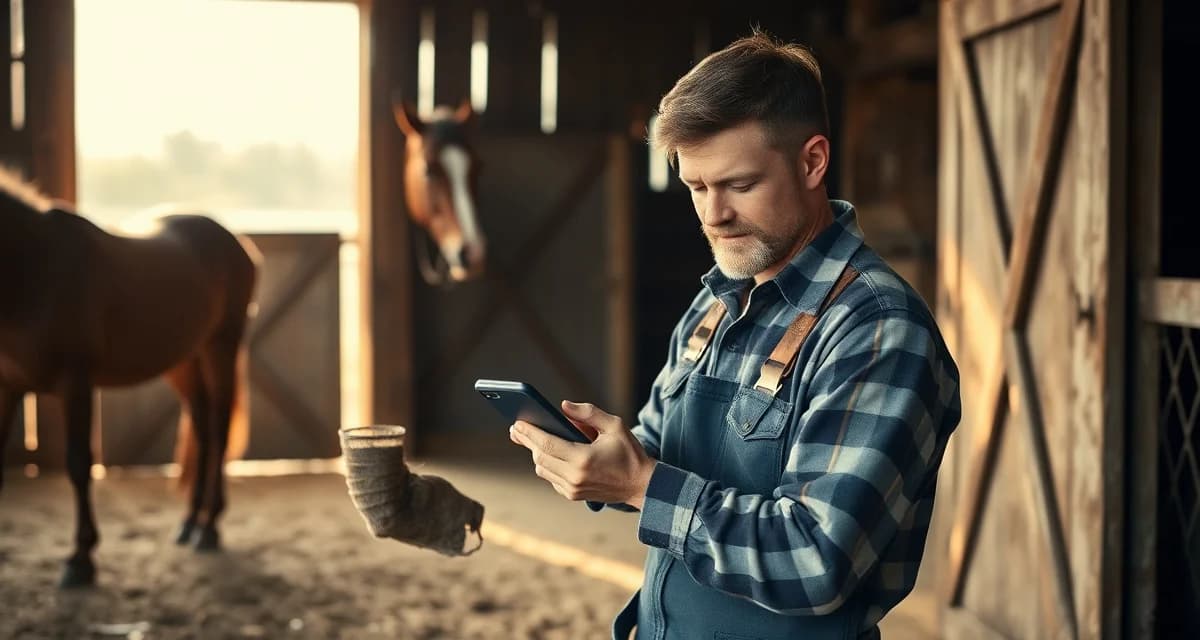
Farrier Software for Rural Communities: Offline-First Tools for No-Signal Barns
A 2024 survey found rural farriers lose an average of 45 minutes per day to workarounds for poor signal.
TL;DR
- Rural farriers lose an average of 45 minutes per day -- more than 180 hours per year -- to connectivity workarounds: apps that won't load, invoices stuck in outbox, records that won't save with no signal in a barn 40 miles from the nearest cell tower.
- 82% of barn locations have unreliable cell coverage -- the majority of places rural farriers work do not have reliable internet; software that requires connectivity fails at most job sites.
- FarrierIQ stores the complete client book, all horse records, full schedule, and all invoicing templates locally on the device -- when you pull into a farm with no signal, the app works exactly as it does at home with full WiFi.
- Every core feature works offline: horse records, visit notes, hoof condition updates, professional invoices (queued for sending when signal returns), schedule updates, new horse and client entries.
- At a conservative $60/hour farrier rate, 180 hours of lost productivity per year equals $10,800 annually -- recovering even 20% of that through offline-first software produces a return on investment well above the $49/month subscription cost.
- Syncing is automatic: when you drive back toward a town and signal returns, the app syncs everything without any manual step required.
- Rural farriers using FarrierIQ work through full days of no-signal barn stops with complete workflow functionality, then reconnect and sync automatically -- no manual data entry recovery, no lost records, no stuck invoices. That's more than three hours a week dealing with apps that won't load, invoices that won't send, and records that won't save because there's no internet connection in a barn 40 miles from the nearest cell tower.
Rural signal coverage data shows that 82% of barn locations have unreliable coverage. The majority of the places you work don't have reliable internet. A tool that requires connectivity to function is a tool that fails at most of your job sites.
The Rural Farrier Reality
If you work in rural communities, you already know this. You've had the experience of trying to pull up a horse's record in a barn while watching your signal drop to nothing. You've sent an invoice that's sitting in your outbox because it can't connect. You've had to write down notes on paper because the app wouldn't save offline.
These aren't edge cases. They're the normal daily experience of rural farrier work.
The solution isn't better cell coverage. You can't control that. The solution is software built to work without it.
How FarrierIQ's Offline App Works
FarrierIQ is designed from the ground up as an offline-first application. Your complete client book, every horse's records, your full schedule, and all your invoicing templates are stored locally on your device. Not in the cloud. On your phone.
When you pull into a farm with no signal, FarrierIQ works exactly as it does in your kitchen with full WiFi. You pull up the horse's record. You complete your visit. You add notes. You generate and send the invoice. You update the schedule.
All of that happens locally. When you drive back toward a town and your signal returns, the app syncs everything automatically. The client gets their invoice. Your records update in the cloud. The schedule adjusts. You don't have to do anything.
What Rural Farriers Can Do Offline
Every core feature works offline:
- View complete horse records and hoof condition history
- Add visit notes and hoof condition updates
- Generate and queue professional invoices for sending
- Update your schedule and mark appointments complete
- Review your route for the rest of the day
- Add new horses or client notes
The only thing that requires connectivity is sending invoices via email or text, which queues automatically and delivers when signal returns.
The Real Cost of Connection-Dependent Apps
If you're losing 45 minutes per day to connectivity workarounds, that's more than 180 hours per year. At a conservative farrier rate of $60 per hour, that's $10,800 per year in lost productivity. Switching to an offline-first tool doesn't just reduce frustration. It has real financial value.
FarrierIQ costs $39 per month. Even if it only recovers 20% of that lost time, the return on investment is more than 10:1.
Scheduling Software That Works Everywhere
Beyond offline functionality, rural farriers need scheduling tools built for the realities of rural work. Longer drive times between stops. Clients who aren't always reachable by text. Farms that may not have current contact information on file.
FarrierIQ's scheduling handles the rural context. You can set longer intervals for isolated clients. You can add travel time buffers to your rural days. You can keep notes about specific farm access requirements that your suburban tools would never think to ask about.
Frequently Asked Questions
What farrier software works without internet?
FarrierIQ is built offline-first, meaning it functions fully without any internet connection. All core features, records, notes, invoicing, and scheduling, work on your device without requiring connectivity. It's the only farrier-specific app designed this way.
How do I manage horse records in a barn with no cell signal?
With FarrierIQ, you manage them exactly as you would anywhere else. The app stores all records locally on your device. You open a horse's record, add your visit notes, and the information is saved locally. When connectivity returns, it syncs to the cloud automatically.
Is there an offline farrier app for rural areas?
FarrierIQ is specifically designed for this use case. Its offline-first design came from listening to rural farriers describe the problem with every other option. It's not a feature that was added as an afterthought. It's the foundation of how the app works.
What happens to data entered offline if you forget to reconnect before the end of the day?
Nothing is lost. FarrierIQ stores all offline data locally on the device until the next time you reconnect to any network -- WiFi, cell data, or a mobile hotspot. You can work without connectivity for multiple days in a row and the data is preserved on your device throughout. The sync happens automatically the next time the app detects a connection, without any manual step required. The only practical risk is if you lose or destroy the phone before syncing, which is why FarrierIQ recommends enabling regular device backups through your phone's native backup system (iCloud for iOS, Google backup for Android) so local data is protected against device loss.
How should rural farriers handle clients who are unreachable between visits?
Rural clients on remote properties may not receive texts reliably, may have no email access, and may be genuinely difficult to reach by phone if they're out working. The practical approach is to establish the scheduling expectation at the first visit: "I'll come back in [interval] weeks. If that date doesn't work, contact me at least a week before." Clients who understand the interval expectation upfront are more likely to plan around it. For rural clients where reminders are likely to fail due to connectivity issues at their property, adjusting the reminder timing to send earlier -- 72 hours rather than 24 hours -- increases the odds that the message arrives when the client is in coverage. FarrierIQ's automated reminder tools let you set custom reminder timing per client, so rural clients get earlier outreach than suburban clients who receive texts reliably.
What route planning approach minimizes the impact of rural drive time on daily horse count?
Corridor-based routing -- grouping rural clients by the geographic corridor they're located in and running one corridor per day -- is more effective than geographic clustering at the town level. A farrier serving eastern Montana ranch country, for instance, might plan a "Highway 2 corridor day" covering clients along a single road for 80 miles before backtracking, rather than mixing Highway 2 stops with Highway 87 stops that require cross-country drives between corridors. The key insight is that in rural territory, the direction of travel matters more than absolute distance between stops. FarrierIQ's route optimization tools sequence stops based on actual road distances, which tends to produce corridor-based results automatically when applied to truly rural client distributions.
Sources
- American Farrier's Association (AFA), rural farrier business resources and member directory
- National Rural Health Association, rural connectivity and infrastructure resources
- American Association of Equine Practitioners (AAEP), rural equine practice resources
Get Started with FarrierIQ
Rural farriers losing hours per week to connectivity workarounds use FarrierIQ's offline-first platform to recover that time and run complete professional workflows from any barn regardless of signal. For farriers serving rural horse communities where reliable cell coverage cannot be assumed, farrier software for rural communities provides the offline-first foundation that professional rural farrier practice requires.