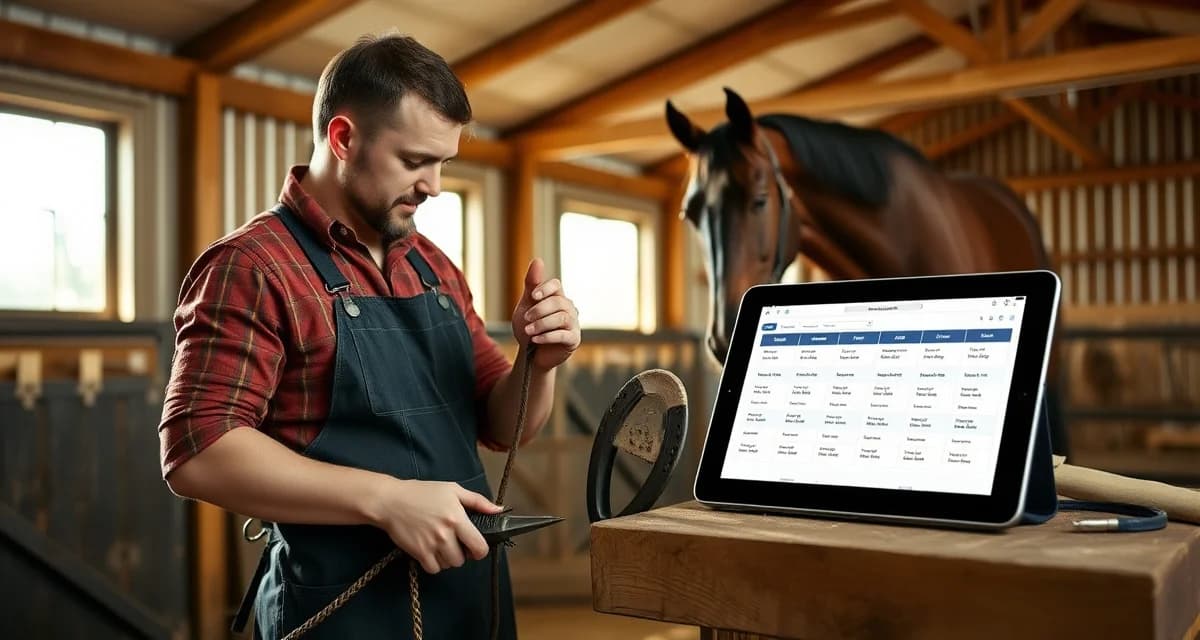
From Paper Records to 180 Horses: A Texas Rural Farrier's Digital Transition
When Ray started thinking about switching from paper records to digital, his first question was the one every rural Texas farrier has: what happens when I'm out of cell range?
He'd heard about other farriers trying web-based apps that went completely blank when they drove past Fredericksburg and out into the Hill Country. He'd tried one himself for a week before giving up after the third time he couldn't pull up a client record at a ranch without a signal. 18 months after going digital this TX farrier grew from 90 to 180 horses on his route -- but the growth only happened because the tool he switched to actually worked in the places he worked.
TL;DR
- Ray's paper system had accumulated friction across 90 horses and 6 years: billing ran 3-5 days behind, a few horses were suspected overdue with no system to confirm which, and a vet call about a horse meant the record was in a notebook in the truck rather than immediately accessible.
- The offline requirement eliminated most competitors immediately -- Ray tested FarrierIQ by pulling up a dozen records at a ranch with no signal, adding a visit note, and sending an invoice; everything loaded and synced when he reached coverage on the way home.
- Entry of all 90 horses into FarrierIQ took about 3 weeks at 10-15 horses per evening; full workflow running digitally by week 6; paper notebook in the truck as backup for one more month, then archived.
- Route optimization found a 34-mile reduction on his Tuesday route alone -- he was skeptical but ran it, and it was 34 miles shorter; combined with other day improvements he recovered 90 minutes per day.
- 90 recovered minutes per day plus no evening billing sessions gave Ray genuine capacity; he added 40 horses in the first 12 months and another 50 in the next 6 months -- 180 horses, 18 months, same service area.
- FarrierIQ at $49/month is covered by fuel savings from route optimization alone ($280/month from his route reductions); the time converted to additional horses generated additional annual revenue in the tens of thousands.
The Paper System Problem
Ray's paper system wasn't terrible by farrier paper standards. He kept a spiral notebook in the truck organized by client, with visit notes in chronological order. He had a separate ledger for billing and a folder of receipts. For 90 horses, he'd been making it work for six years.
The problems weren't catastrophic. They were accumulating friction:
- Finding a specific horse's record in the notebook required flipping through pages
- He sometimes arrived at a ranch not remembering which specific horses were due that day
- Billing was always running 3 to 5 days behind because he'd enter invoice data in the evenings
- He had a few horses he suspected were overdue but had no system to confirm which ones or how overdue they were
- When a vet called about a horse, the relevant information was in a notebook in the truck, not immediately accessible
None of these were individual crises. Collectively, they were a drag on his ability to take on more horses without adding proportional time and stress.
Why He Chose FarrierIQ Over Other Options
The offline requirement was the filter that eliminated most competitors immediately. Ray works regularly in areas of the Texas Hill Country, the ranchland between San Antonio and the Edwards Plateau, and rural stretches of the I-10 corridor where cell coverage is genuinely unreliable. Any software that required a signal to function wasn't a real option regardless of its other features.
FarrierIQ's offline-first design stores the complete horse book, schedule, and invoicing capability on the device. Ray tested it by pulling up a dozen horse records while parked at a ranch with no signal. Everything loaded. He added a visit note and sent an invoice. When he drove back into coverage on the way home, everything synced automatically.
That single test sold him. The rest of the features -- route optimization, automated reminders, AI flagging -- were bonuses he discovered over the following months.
The 90-Day Transition
Ray entered all 90 of his active horses into FarrierIQ over three weeks, doing 10 to 15 horses per evening after his workday. He used the intake process to review each horse's notes from the paper record and decide what was worth transcribing versus what could stay in the archive folder.
By week 4, all active horses were in the system. By week 6, he was running his scheduling and invoicing entirely through FarrierIQ. The paper notebook stayed in the truck as backup for another month, then graduated to the office filing cabinet.
The transition was not painless -- no honest assessment of switching systems would claim that. He made a few data entry errors in week one that required correction. He had to learn the app's navigation while also doing his normal workday. But the offline-first design meant the learning curve didn't interfere with his work because the system never failed him when he was at a ranch without coverage.
The Route Optimization Discovery
About 3 months in, Ray ran his entire service area through FarrierIQ's route optimization for the first time. He was covering the Hill Country and surrounding areas with what he thought were reasonably efficient routes -- he'd lived there his whole life and knew the roads.
The optimizer suggested a restructuring that would reduce his Tuesday route by 34 miles. He was skeptical. He ran it anyway. It was 34 miles shorter. He'd been taking a route through one ranch to reach another that made geographic sense to him but added unnecessary mileage compared to an alternate approach he'd dismissed as "the long way."
That 34 miles on Tuesday was meaningful in Texas Hill Country driving -- 40 to 50 minutes at the speeds those roads allow. He found similar improvements on two other days when he optimized those routes. Combined, he was recovering about 90 minutes per day.
How the Book Doubled
With 90 extra minutes per day recovered from routing and no longer losing evenings to paper billing, Ray had genuine capacity he hadn't had before. He started taking referrals he'd been declining. He scheduled some of the calls that had been sitting on a "maybe later" list.
The first 12 months, he added 40 horses. The following 6 months, another 50. Eighteen months in, he was at 180 horses -- the same individual working the same general service area, just using the available time better.
The growth wasn't effortless. He had to get better at route discipline (new clients had to fit into existing zone blocks, not create islands that generated inefficient detours). He had to handle a higher volume of invoices. But FarrierIQ's invoicing tools scaled with the volume without adding proportional time -- one-tap invoicing at 180 horses takes the same seconds per invoice as it did at 90.
What It Cost and What It Returned
FarrierIQ runs $49/month. At Ray's average ticket, a single additional appointment more than covers a month's subscription. The fuel savings from route optimization -- roughly $280 per month based on his route reduction -- more than pays for the subscription independently. The recovered time, converted to additional horses, generated additional annual revenue in the tens of thousands of dollars.
He stops sometimes and thinks about the six years he spent on a paper system that was constraining his growth without him fully realizing it.
Frequently Asked Questions
How do rural farriers go digital without cell coverage?
The key is choosing a platform built for offline use, not a web-based platform that requires connectivity. FarrierIQ's offline-first design stores your complete horse book, schedule, and invoicing capability on your device. You access records, add notes, and send invoices in the field without a signal. When you return to coverage, everything syncs automatically. Web-based platforms (like iForgeAhead) require a connection for every operation -- they're simply not functional in rural areas with spotty coverage.
Can a farrier app work on a Texas ranch without internet?
FarrierIQ works fully on a Texas ranch without internet. Every horse record, the day's schedule, and the invoicing function are stored locally on your phone or tablet. You can pull up a horse's two-year history, add visit notes, and send an invoice while standing in a pasture with no cell signal. This is the baseline requirement for any app that rural Texas farriers can actually rely on in their day-to-day work. Apps that require internet access simply can't meet this requirement.
What happened when a Texas farrier switched from paper to FarrierIQ?
Ray entered his 90 active horses into FarrierIQ over three weeks, then spent about 6 weeks getting his full workflow running digitally. Route optimization reduced his daily mileage and recovered 90 minutes per day. Automated invoicing eliminated the evening billing sessions. The combined time recovery, plus the operational improvements from organized records and overdue alerts, gave him genuine capacity to expand. Over 18 months, his book grew from 90 to 180 horses -- the same farrier, same general service area, doubled results from better tools.
How should a rural farrier handle the initial data entry phase when switching from paper?
Start with your most active horses -- the ones you see most frequently -- and work backward from there. 10 to 15 horses per evening is a sustainable pace that gets a 90-horse book into the system in about three weeks without burning out on data entry. Don't try to transcribe everything from your paper records: enter the current shoe specification, the last three visit dates and notes, any health flags you're actively monitoring, and the owner contact details. Historical records before the last 6 months can stay in the paper archive. You're building a functional working record, not a complete historical archive. Keep the paper backup in the truck for the first month so you're not dependent on the new system before you've confirmed it works in your specific coverage conditions.
What's the right way to handle a ranch client who is skeptical of digital invoicing?
Explain that digital invoicing doesn't replace their preferred payment method -- they can still pay by check if they want; the invoice just arrives faster and gives them a record they can find on their phone. Most ranch clients' skepticism is about payment method change, not about receiving a digital document. Frame it as a convenience addition rather than a requirement to change how they pay. In practice, most clients migrate toward card or bank transfer within a few months once they realize how much easier it is. Log their payment preference in FarrierIQ so you're not re-explaining the arrangement each visit, and track which clients are still on checks after 6 months to see if a quiet mention during a visit might be worth trying.
Sources
- American Farrier's Association (AFA), farrier technology adoption and digital transition resources
- Texas A&M AgriLife Extension, rural Texas equine industry and ranch operations data
- American Farriers Journal, rural farrier operations and paper-to-digital transition case studies
- Professional Farrier Magazine, offline technology requirements for rural farrier practices
Get Started with FarrierIQ
Ray's transition from 90 to 180 horses came from a tool that actually worked where he worked. The offline-first design was the non-negotiable baseline, and the route optimization and automated invoicing were what freed up the time to grow. FarrierIQ's offline-first design works in Texas Hill Country ranches, rural I-10 corridors, and anywhere else cell coverage is unreliable. Try FarrierIQ free and test it at a location without coverage before you commit.