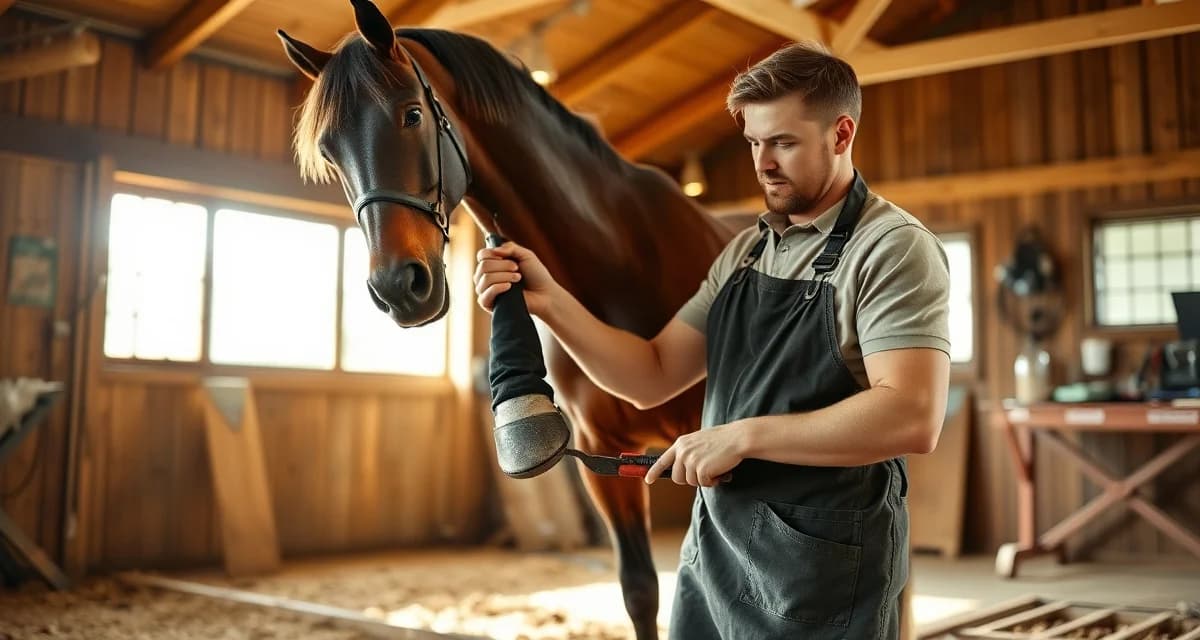
How One Solo Farrier Manages 50 Horses With Just a Phone and a Good Route
Jake Mercer started his farrier business six years ago with a truck, a basic tool set, and a spiral notebook. By year three, the notebook had become a problem.
He had 47 horses on his book, spread across 22 clients in a three-county area of central Virginia. Some were 6-week horses, some were 5-week competition horses, some were barefoot trims every 8 weeks. Keeping the schedule in his head meant he was constantly making reminder calls, occasionally missing a horse that had slipped off the mental list, and spending Sunday evenings trying to rebuild the next week's schedule from a mix of texts and notebook scribbles.
"I'd drive 45 minutes to a barn and get there and the horse was out in the field, not caught," he says. "I'd had my phone in my pocket the whole drive. I could have fixed that with a text two days before. I just didn't have a system."
TL;DR
- Jake Mercer managed 47 horses across 22 clients in a three-county area before switching to a digital system - his paper-based approach was costing him real money.
- His invoice collection rate was only 78%, meaning roughly $19,000 of billed work per year was not being collected; digital invoicing pushed that to 96%.
- Route optimization reduced his average daily drive from 180 miles to 147 miles, saving approximately $140/month in fuel costs.
- Automated 48-hour reminders eliminated missed appointments entirely and replaced manual reminder call rounds that were eating into his working hours.
- Switching to FarrierIQ recovered about 3 hours per week in admin time - worth $300+/week for a solo farrier billing at $100+/hour effective rate.
- The biggest financial impact was not new revenue but recovering money already earned: the collection rate improvement alone put roughly $15,600 more into Jake's account annually.
- Variable shoeing cycles (5, 6, and 8-week) cannot be reliably tracked on a paper calendar at scale - software that surfaces upcoming appointments automatically is the practical solution.
The Situation
Jake's business at the time:
- 47 horses, 22 clients
- Solo operation - no apprentice, no helper
- Three-county territory, average 180 miles driven per working day
- Mix of pleasure horses, a few hunter-jumper clients, and three small breeding operations
- Annual revenue approximately $87,000, invoice collection rate around 78%
The 78% collection rate was the number that bothered him most. He was doing $87,000 worth of work per year and collecting about $68,000. The gap wasn't outright refusals - it was slow payers, invoices that got lost, and bills he forgot to follow up on because he didn't have a reliable aging report.
The Problem
Three specific problems were costing Jake money and time:
Problem 1: Scheduling was a mental exercise that created errors.
With horses on 5, 6, and 8-week cycles, the next appointment date for each horse was a moving target. Jake tracked it mentally with a paper calendar backup, but the system had too many failure points. He'd occasionally discover a horse was 9 or 10 weeks out from its last shoeing because the reminder call had slipped. That's not good for the horses and it's not good for the client relationship.
Problem 2: Drive time was unoptimized and expensive.
Jake's daily routes were built on habit and the order clients had called rather than geographic logic. He estimated he was making U-turn-style routes several times a week - driving north, then back south, then north again - burning an extra 30-45 minutes per day in redundant mileage.
Problem 3: Invoice collection was manual and inconsistent.
After each appointment, Jake wrote a paper invoice, handed it to the owner (or left it in the barn office if no one was around), and followed up by phone or text. Busy clients lost invoices. Others paid slowly because there was no deadline or digital convenience. His 30-day invoice-to-payment average was running around 47 days.
The Solution
Jake started using FarrierIQ at the recommendation of another farrier he met at a clinic in February of the previous year.
The transition took about two weeks. He entered all 47 horses with their owners, locations, and shoeing cycles. Pulled old invoices to establish last service dates. Set up the client portal for his three biggest clients first, then worked through the rest.
What changed immediately:
The scheduling became automatic. FarrierIQ generated his upcoming schedule from the horse roster and cycle data he'd entered. For the first time, he could see his full 8-week rolling schedule on a single screen - who was coming up, in what order, and when.
Automated reminders went to horse owners 48 hours before each appointment. His client who ran the small breeding operation - someone who had previously missed two appointments a year because she "forgot it was that time" - confirmed every appointment on the first reminder for the next 8 months.
What changed in the first 60 days:
Route optimization cut Jake's average daily drive from 180 miles to approximately 147 miles. The optimizer arranged his stops geographically rather than in call order, eliminating the zigzag patterns. On a 12-week basis, that was over 400 fewer miles driven - roughly $140 in fuel savings.
One-tap invoicing sent digital invoices to clients immediately after each appointment, while Jake was still at the barn packing up. Clients received an email with a payment link. His 30-day collection period dropped from 47 days to 19 days. Invoices stopped getting lost in barn office piles.
The Results
Six months after starting FarrierIQ:
- Invoice collection rate up from 78% to 96% - the combination of immediate digital invoicing and clear payment links eliminated most slow-pay situations
- Daily drive time reduced by 35 miles/day on average - saving approximately $140/month in fuel
- Zero missed shoeing appointments - the automated schedule flagged every horse approaching its service window
- Reminder call time reduced to near zero - automated reminders through the owner portal replaced manual call rounds
- Time saved on scheduling and administration: approximately 3 hours/week
The collection rate improvement was the biggest financial impact. Going from 78% to 96% collection on $87,000 in billed work meant roughly $15,600 more cash actually hitting Jake's account. That's not revenue - he was doing the work before - it's money he was leaving behind because the billing system was too leaky.
"I added one horse and it took me 30 seconds," he says. "Used to be I'd have to figure out where to put it on the calendar, write down the address, remember to call the owner before the first visit. Now I just enter the horse and the app handles the rest."
Key Takeaways
1. The invoice gap is almost always bigger than farriers realize.
If you're collecting under 90% of your billed revenue, the collection system is the problem, not the clients. Digital invoicing with immediate delivery and payment links closes the gap dramatically.
2. Scheduling systems need to handle variable cycles.
A farrier with horses on different 5, 6, and 8-week cycles can't manage that reliably from a paper calendar. Software that tracks individual cycles and surfaces upcoming appointments automatically is the correct tool for the job.
3. Route inefficiency is a real, quantifiable cost.
Unoptimized routes cost money every single working day. The savings compound over weeks and months into significant fuel and time savings. Farriers looking to reduce overhead should look at farrier route planning strategies before adding more horses to their book.
4. The admin time you're spending is not fixed.
Jake recovered 3 hours per week from scheduling, reminder calls, and invoice follow-up. For a solo operator at $100+/hour effective rate, that's $300/week of recovered time - time he can spend on additional horses, on skills development, or on rest.
Related Articles
FAQ
Can one farrier really manage 50 horses solo?
Yes - many solo farriers manage 50-100+ horses without staff. The key variables are geographic concentration (horses clustered in a manageable area), efficient scheduling, and good administrative systems. A farrier managing 50 horses spread over 200 miles will burn out faster than one managing 50 horses in a 30-mile radius.
How does FarrierIQ help with invoice collection?
FarrierIQ sends digital invoices immediately after each appointment via email. Horse owners get a payment link and can pay online. The invoice history is visible in the app, and overdue invoices are flagged. The combination of immediate delivery and digital payment options typically cuts days-to-payment in half or better.
What's a realistic book size for a solo farrier?
Most solo farriers maintain 50-150 horses depending on geographic density, mix of services, and physical capacity. A book of 100+ horses spread tightly is more manageable than 75 horses spread across a large rural territory. The limiting factors are drive time, physical endurance, and administrative capacity - good software eliminates much of the administrative constraint.
How long does it take to get set up on farrier management software?
Jake's transition took about two weeks, which included entering 47 horses with full cycle data and pulling old invoices to establish last service dates. Most farriers can expect a similar setup window. Starting with your highest-volume clients first, as Jake did, lets you see results quickly while you work through the rest of the roster.
Does digital invoicing actually change how fast clients pay?
In Jake's case, his average days-to-payment dropped from 47 days to 19 days after switching to immediate digital invoicing with payment links. The main reasons are convenience (clients can pay from their phone without writing a check) and visibility (the invoice arrives while the appointment is still fresh, rather than sitting in a barn office pile). Clients who previously lost paper invoices stopped being slow payers once invoices arrived by email.
What happens to hoof records when a horse changes farriers or moves barns?
FarrierIQ stores hoof records tied to the individual horse profile, not just the client account. If a horse moves to a new barn under the same owner, the service history stays intact and the location can be updated without losing any historical data. This is particularly useful for farriers working with breeding operations or competition clients whose horses move between facilities seasonally.
Sources
- American Farrier's Association (AFA) - industry standards, farrier business practices, and continuing education resources
- Farrier Business Management, University of Minnesota Extension - equine industry workforce and small business guidance
- American Association of Equine Practitioners (AAEP) - hoof care scheduling guidelines and equine health recommendations
- United States Department of Agriculture National Agricultural Statistics Service (USDA NASS) - equine industry census and horse population data by region
- Farriers' Journal - trade publication covering farrier business operations, tools, and industry trends
Get Started with FarrierIQ
If Jake's situation sounds familiar - a growing horse roster, routes built on habit rather than geography, and invoices that take too long to collect - FarrierIQ is built specifically for solo farriers managing exactly this kind of complexity. You can try FarrierIQ free and have your full horse roster entered, your cycles set, and your first optimized route ready within a couple of weeks. The collection rate improvement alone tends to pay for the software many times over.