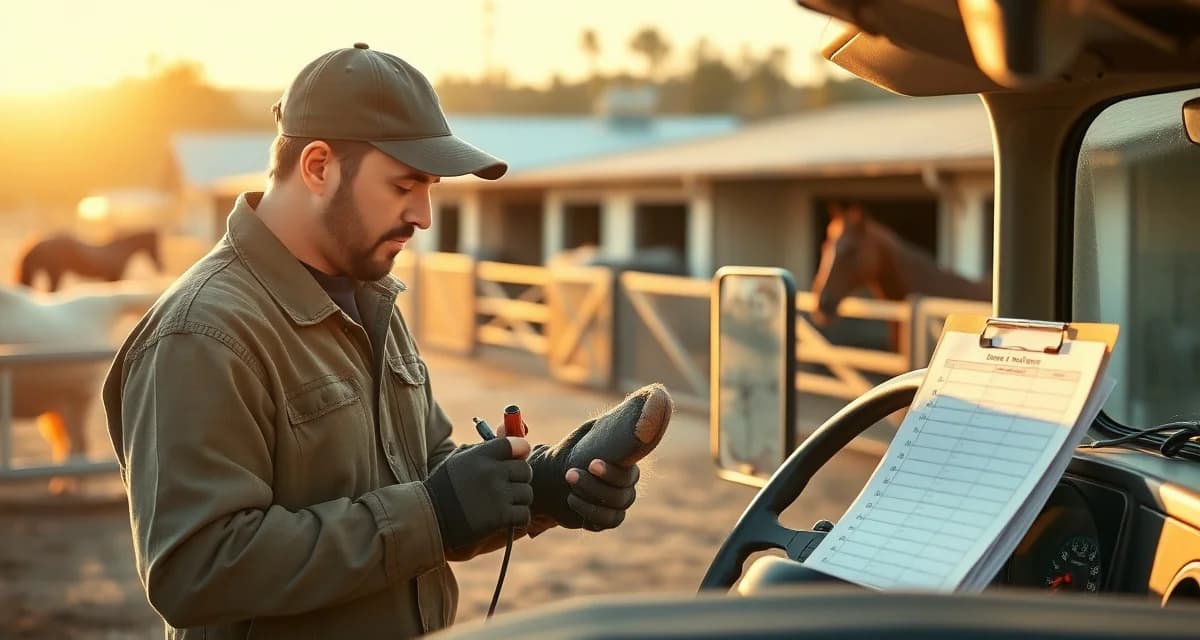
A Day in the Life of a Farrier Managing 150 Horses: Route Scheduling and Staying Sane
At 150 horses, you're running a real business. Not a side hustle, not a one-person shop with a paper notebook -- a business that bills $150,000-200,000+ per year and needs actual systems to function.
TL;DR
- At 150 horses, gross revenue runs $180,000-225,000 per year at average rates of $1,200-1,500 per horse annually -- this is a business that requires business-level systems to operate efficiently.
- A well-run 150-horse day covers 7 stops and 26 horses across an optimized 52-mile route -- without route optimization, the same stops can add 40+ minutes of unnecessary driving per week.
- Voice memos into FarrierIQ while working capture hoof condition observations with the foot still in hand -- the most accurate time to record what you're seeing, not hours later from memory.
- Invoicing from the parking lot immediately after each stop (not at week's end) is one of the highest-impact income practices for high-volume farriers.
- Automated appointment reminders sent the morning of each stop eliminate the follow-up calls that consume time at 150 horses.
- The gap between a well-run 150-horse day and a poorly-run one is tens of thousands of dollars per year -- not in what you charge, but in administrative friction, lost horses, and collection delays.
The farriers who make it to 150 horses without burning out, losing clients, or developing chronic back problems have figured out something most of the industry is still learning: the administrative load of a large book is as physically demanding as the work itself if you let it run on manual systems.
Here's what a well-run day looks like at 150 horses -- and what the cracks look like if the systems aren't right.
5:45am -- Before the First Farm
The day starts in the driveway, not at the first stop. A well-prepared 150-horse farrier knows the day's route before they leave home.
With FarrierIQ open: today's appointments are already scheduled, route-optimized, and showing 7 stops across a 62-mile loop. Horse names and notes for each stop are visible. The last visit record for every horse on today's list is one tap away -- what shoe was on, what condition was noted, anything the vet communicated.
Coffee in hand, trailer hitched, tools loaded. On the road by 6:15.
What this looked like with a paper system: 20 minutes reconstructing today's schedule from last week's notebook, two phone calls to confirm horses that weren't confirmed, five minutes on Google Maps plotting a rough route, and a nagging feeling that you might be forgetting someone.
7:00am -- First Stop: Eight Horses at a Hunter-Jumper Barn
Eight horses at one location is a good start to the day. They're all in, owners are mostly not present (the barn manager is), and there's a clear work order.
Horse one: pull old fronts, note white line tracking started at the toe of the right front -- worse than six weeks ago. Voice memo into FarrierIQ while the foot is still in hand: "Right front white line, now extends 1.5cm up wall from toe, debride and pack today, flag for vet if progressing at next visit." The note is attached to that horse's record with today's date, timestamped.
At the end of eight horses -- about three hours -- invoice sent while loading the truck. Barn manager's email gets a PDF of the invoice for the whole string. Payment due in 30 days. The invoice populates automatically from today's appointment records.
10:30am -- Drive Time: 23 Minutes to Stop Two
The route optimizer put this stop second for a reason -- it's directly between stop one and stop three with no backtracking. Before FarrierIQ, this farrier's route put these stops on different days because they called in at different times. That was an extra 40 minutes of driving on a given week.
No signal for 8 miles through here. Doesn't matter -- everything is cached locally.
11:00am -- Stop Two: Four Horses, One Problem
Three of the four go smoothly. Horse four -- a 14-year-old warmblood with navicular changes -- is moving differently than six weeks ago. More reluctant on the right front. Pull up the record from last visit: noted mild sensitivity at the toe last time, used a modified egg bar. Owner isn't here.
Record what you're seeing. Voice memo: "More pronounced sensitivity right front compared to last visit, moving shorter-strided, recommend vet flexion test before next shoeing, leaving on current setup." Text the owner from the parking lot. She responds 20 minutes later: "I noticed that too, calling the vet today."
That exchange -- your observation, your record, your communication -- is what separates a professional farrier from a technician. The record is there if the vet calls in three weeks asking what you saw.
1:15pm -- Lunch in the Truck: Not Optional at 150 Horses
Eat. Hydrate. You're three stops into a seven-stop day in mid-June. The afternoon will be 88°F in direct sun.
While eating: two appointment reminders went out automatically this morning to owners at today's stops 5 and 6. One confirmed immediately. Checking the app -- stop 6 hasn't confirmed yet. Send a follow-up text now, not after you've driven 20 minutes and found an empty barn.
1:45pm -- Stop Three: Six Horses, Two New Shoes, Four Resets
New shoes on two horses that have been on resets for the last few cycles. Both are competition horses entering show season -- owners wanted fresh plates. This stop takes 2.5 hours. One horse is difficult -- a 6-year-old TB mare who's been getting better but still needs extra time.
The slow horse is in the records: "Allow extra time, suggest standing wraps for handling, works better with bay-scented fly spray off." This isn't in your head. It's in the app, and you read it before you pulled into the driveway.
Invoice sent at 4:15 while loading.
4:30pm -- Stops Four and Five: Three Horses Each
Routine stops. Experienced horses, experienced owners. Thirty minutes at each. These are the ones that make a long day manageable.
At stop five: the owner mentions she has a new horse coming in two weeks that needs work. You add the horse to FarrierIQ while you're standing in the barn aisle. Name, breed, approximate age, her contact info, and a note that it's a new intake needing an initial assessment. The horse is on the schedule. Cycle set to 6 weeks pending first visit. No chance of it falling through the cracks.
6:00pm -- Final Stop: Three Horses, Therapeutic Work
The day ends with a 20-year-old Quarter Horse mare on a heart bar shoe for chronic laminitis. This is careful, slow work. She's done well on the heart bar for 18 months -- sole is building, she's comfortable in turnout. The owner is there, wants to talk through the vet's latest recommendations.
Pull up the shoeing history: 8 visits on the heart bar, sole depth notes, vet communications logged. You have the full picture. The conversation with the owner is grounded in actual data, not memory.
Final invoice sent at 7:45pm. Day complete.
The Numbers
A day managing 150 horses efficiently:
- 7 stops, 26 horses
- 52 miles driven (optimized)
- 3 invoices sent immediately, 3 sent from parking lots, 1 sent from the truck at end of day
- 2 voice memos recording hoof condition observations
- 1 new horse added to the book
- 0 phone calls made for reminder purposes
- 1 follow-up text to a client about a vet referral
Without a system, this day involves more driving, reminder calls, paper invoices left in barn offices, and observations that don't get recorded. At 150 horses over a full year, the gap between those two versions of the same day is tens of thousands of dollars.
Related Articles
- Farrier App for Washington DC Area: Managing Northern VA and MD Suburban Horses
- Farrier Scheduling for Endurance Horses: Miles of Hoof Care
- Farrier Scheduling for Jumper Horses: Balanced Hooves for Impact
FAQ
How many horses can a farrier see in a day?
Most experienced farriers see 6-12 horses per day depending on service mix, travel time, and horse behavior. A day of all trims on cooperative horses might reach 12-15. A day with several difficult horses or extensive therapeutic work might be 6-8. The limiting factors are physical endurance, travel time, and the quality of administrative support systems.
How do high-volume farriers stay organized?
The key tools are: a per-horse record system with shoeing history, a schedule that generates from cycle data rather than manual entry, route optimization to minimize drive time, and digital invoicing that goes out same-day. Farriers managing 100+ horses who rely on paper systems consistently report higher administrative stress and lower collection rates than those using dedicated apps.
What does a 150-horse book earn?
At average revenue of $1,200-1,500 per horse per year (mix of standard and therapeutic work), a 150-horse book generates $180,000-225,000 in gross revenue. After costs (fuel, tools, insurance, supplies, app subscriptions), a solo farrier should net $120,000-160,000. This varies significantly by region, service mix, and collection rate.
At what point does a growing farrier book require dedicated software?
The tipping point is usually around 50-60 horses. Below that, a well-organized paper system or basic calendar app can handle the scheduling and records. Above 60 horses, the administrative overhead of manual scheduling, individual reminder calls, and paper invoices starts consuming meaningful time that could be spent on additional horses or recovery. By 100 horses, farriers without dedicated software are consistently slower to collect payments, more likely to have horses fall behind their intervals, and spending 2-4 extra hours per week on administrative work. The best farrier app for large books guide covers the specific features that matter most as book size grows.
How do experienced high-volume farriers handle therapeutic cases in the middle of a production day?
Therapeutic cases -- laminitis management, corrective shoeing for navicular, heart bar work -- take significantly longer than a standard reset and require a different quality of attention. High-volume farriers who handle therapeutic cases well typically schedule them at the beginning or end of the day rather than in the middle of a production run. A complex therapeutic case at stop 4 of a 7-stop day creates scheduling pressure that can affect the quality of the remaining stops. Keeping therapeutic work in its own scheduling block, often with the record pulled up and reviewed before arrival, produces better outcomes for the horse and less stress on the day's overall schedule.
Sources
- American Farrier's Association (AFA), business management and practice development resources for professional farriers
- Professional Farrier Magazine, high-volume practice management and business operations coverage
- National Institute for Occupational Safety and Health (NIOSH), physical sustainability guidelines for outdoor tradespeople
- Farrier business community forums and association publications, practice management data and benchmarks
Get Started with FarrierIQ
At 150 horses, the administrative difference between a well-run and poorly-run day compounds into tens of thousands of dollars per year. FarrierIQ's route optimization, automated reminders, same-visit invoicing, and per-horse records eliminate the administrative friction that slows high-volume practices. Try FarrierIQ free and see what a fully systemized day at your scale looks like.