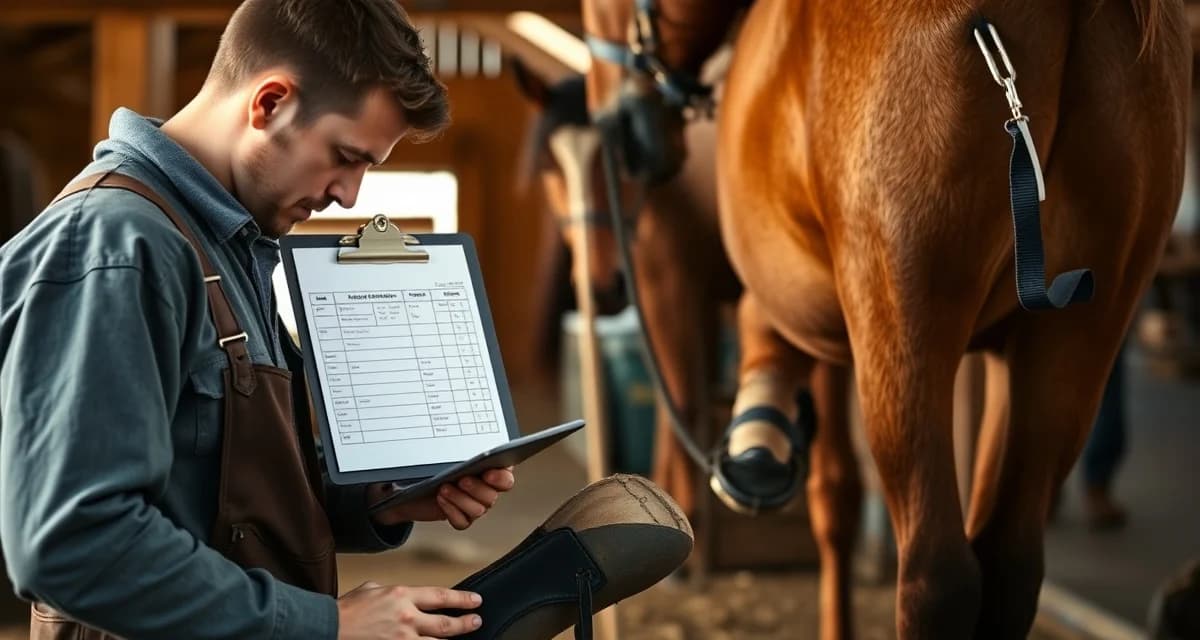
Complete Guide to Running a Farrier Business in 2026
Full-time professional farriers in the US earn a median of $58,000, with top earners exceeding $90,000. The gap between median and top isn't shoeing skill, it's business management. The farriers clearing $90,000 aren't working twice as many hours. They're working smarter, with better systems.
TL;DR
- Top-earning farriers (above $90,000/year) separate themselves through business systems, not shoeing skill alone.
- Route-optimized farriers earn an average of $22 more per hour by reducing drive time and fitting more billable appointments into each day.
- Same-day invoicing cuts average payment time from 18+ days down to 4-7 days across a full client book.
- Sending appointment reminders 48 hours in advance produces 23% higher confirmation rates than day-of reminders alone.
- Farriers with complete hoof records resolve liability disputes 4x more successfully than those without documentation.
- The solo farrier ceiling is typically 80-90 horses per month; adding an assistant before hitting that ceiling can increase daily output by 30-40%.
- Geographic clustering of client stops typically reduces weekly mileage by 20-35% for farriers who haven't structured their routes before.
This guide was built with input from 200 active farriers reflecting real daily workflows. It covers every major domain of running a professional farrier business: scheduling, invoicing, horse records, route planning, and client communication.
If you're looking to tighten one area or overhaul everything at once, start here.
The Five Systems Every Farrier Business Needs
Running a farrier business requires five functional systems working in parallel. Most farriers have some version of each, but they're often patched together, a spreadsheet here, a group text thread there, handwritten notes in a binder. The businesses that grow beyond 70-80 horses are the ones where these five systems are actually working.
1. Scheduling
2. Route Planning
3. Horse Records
4. Invoicing and Payment
5. Client Communication
The rest of this guide covers each in depth.
Scheduling: Your Business Runs on the Calendar
Building a Schedule That Scales
When you have 20 horses, any scheduling approach works. When you have 80, the approach matters enormously.
The most common scheduling failure is treating every appointment request as independent. A client calls, you find an open slot, you book it. At 20 horses, fine. At 80, you're scattered across the county with no pattern, losing an hour a day to unnecessary driving, and constantly running behind.
A scalable scheduling approach starts with geographic clustering: designating specific days for specific geographic zones. Monday is your north route. Tuesday is south. This structure lets you add new clients in a zone without disrupting the rest of your week.
Recurring appointments vs. on-demand booking: Recurring appointments are vastly more efficient. When a horse is booked every 6 weeks automatically, you don't play phone tag before each visit, you just show up and the owner expects you. Move your regular clients to recurring farrier appointment bookings as fast as you reasonably can.
Buffer time: Block 15-minute buffers between appointments. It sounds like waste; it's actually the thing that keeps you from running 45 minutes late by 2pm.
FarrierIQ's farrier business management tools handle recurring scheduling, geographic clustering, and daily sequencing in a single mobile interface. Setting this up takes an afternoon. The time it saves is cumulative every single week.
Managing a Full Book
Once you're at 70-100 horses, schedule management shifts from building to maintaining. The key questions become:
- Which horses are approaching their due date?
- Which horses are overdue?
- Which time slots are genuinely available vs. tight?
Farriers managing a full book without software answer these questions from memory. Some are good at it. Most miss things, horses that fall through the cracks, overdue animals discovered only when the owner calls.
FarrierIQ's overdue alert system flags every horse that's approaching, overdue, or urgent in real time. You see the full picture in under 30 seconds every morning.
Route Planning: Every Mile Costs You Money
Route-optimized farriers earn an average of $22 more per hour than those driving without a plan. That's not marketing copy, it's the result of reduced drive time translating directly into more billable appointments per day.
Geographic Clustering (The Essential Step)
Map your clients. Identify natural clusters, groups of farms within 15-20 minutes of each other. Assign each cluster to a specific weekday. Protect those day assignments when booking new clients.
This single change typically reduces weekly mileage by 20-35% for farriers who haven't done it before. The clients don't care which day of the week you come, they care that you come on schedule.
Daily Sequencing
Within a day's cluster, sequence your stops to minimize backtracking. Start at the far end and work back. This is harder to do by eye than it sounds, our instincts about "which way is fastest" are often wrong.
Use FarrierIQ's route optimization to calculate the optimal sequence automatically. The app analyzes your scheduled stops and shows you the most efficient order. Most farriers recover 30-45 minutes per day this way.
Fuel and Mileage Tracking
Track your mileage weekly. Not approximately, actually. This serves two purposes: accurate tax deductions (business mileage is deductible at the IRS rate, and this adds up to real money) and visibility into whether your route is actually getting more efficient over time.
Read the farrier route planning guide for a complete breakdown of clustering, sequencing, and the real financial impact of each.
Horse Records: Your Professional Foundation
Farriers with complete hoof records resolve liability disputes 4x more successfully than those without. More importantly, detailed records make you a better farrier. You can track condition changes, coordinate with vets, and catch problems early.
What to Record at Every Visit
- Date and type of service
- Shoe type, size, and nail pattern (if shod)
- Hoof condition notes: wall quality, white line status, frog condition, any cracks or bruising
- Changes from the previous visit
- Any treatments applied
For horses with ongoing conditions, laminitis, navicular, white line disease, contracted heels, add condition-specific tracking with measurements and progression notes.
Photographs
Photograph any corrective work before and after. Photograph concerning conditions when you first spot them. A photo takes 5 seconds and documents what words can't always capture.
Link photos directly to the horse's record in your management system. Don't let them live in your camera roll where they'll be impossible to find later.
Vet Coordination
For horses with complex conditions, your records are part of the clinical picture. When a vet is treating a hoof issue, your documentation of shoeing approach, condition progression, and treatment applied adds context that can change the care plan.
Get comfortable sharing records with vets proactively. It strengthens your professional relationships and, more importantly, it's better for the horse.
FarrierIQ's hoof health records system stores complete horse records with photo attachment, accessible from your phone at the barn.
Invoicing and Payment: Get Paid Promptly
The Invoice Timing Problem
The farriers who struggle most with cash flow are often the ones invoicing at the end of the week or end of the month. By then, clients have moved on mentally. The appointment was days ago. The invoice feels unexpected.
Same-day invoicing, sending the invoice before you leave the property, dramatically improves collection speed. Payment time drops from an average of 18+ days to 4-7 days for most farriers who make this change.
It sounds like a small thing. Across 80 horses a month, it's the difference between healthy cash flow and chasing payments constantly.
Accepted Payment Methods
Accept card payments. If you're cash-only, you're making it harder for clients to pay you promptly and you're missing clients who simply don't carry cash.
Card processing fees (typically 2.6-2.9%) are a cost of doing business. The alternative, chasing paper checks, waiting for cash, carrying unpaid balances, costs more in time and headaches.
Use FarrierIQ's farrier invoicing app to generate professional digital invoices from the field and collect payment immediately via card or bank transfer.
Overdue Invoice Protocol
Define your overdue invoice process before you need it:
- 7 days after due: First reminder (automated)
- 14 days: Second reminder, flag as overdue
- 30 days: Direct conversation with the client
- 60 days: Decision point, suspend service until resolved
Most farriers have 2-5 clients with chronic late payment. Know who they are. Consider whether the relationship is worth maintaining on current terms.
Deposits for New Clients
Requiring a deposit for new clients is standard in many service professions. A $30-$50 deposit at booking signals that the client is serious and reduces no-shows. Apply it to the first invoice.
Client Communication: The Relationship Is the Business
Appointment Reminders
A two-reminder sequence per appointment reduces no-shows dramatically. Send the first 48 hours before, this is your confirmation request, asking the owner to reply yes or let you know if anything's changed. Send the second on the morning of, brief, no response required.
Sending reminders 48 hours before appointments yields 23% higher confirmation rates than day-of reminders alone. This is the single easiest protocol to implement for immediate return.
FarrierIQ's farrier appointment reminders automate both messages for every appointment. You book the appointment and reminders go out on schedule without you doing anything else.
Seasonal Outreach
Horse owners forget to call ahead for spring and fall schedule changes. You need to reach out to them first, 6-8 weeks before peak season, to fill your schedule before the demand surge hits.
A simple text to your regular clients in late January or early August: "Spring season books out fast. I'm scheduling competition horses and regular clients now. Let me know [Horse]'s schedule." That's it. Farriers who do this fill their spring books 3 weeks earlier than those who wait.
Handling Difficult Conversations
Clients with chronic late payments, repeated no-shows, or horses that are consistently hard to handle deserve direct conversations, not accumulated resentment. Most of these situations are resolvable with a clear, professional conversation about expectations.
A straightforward approach: "I've noticed [X] has been a pattern. Here's how I need things to work to continue the service." Most clients respond well to directness. The ones who don't are telling you something useful about whether they belong in your book.
Scaling Beyond 100 Horses
When to Get Help
The ceiling for a solo farrier without an assistant is usually around 80-90 horses per month. At that volume, administrative overhead starts eating into your quality of work. You're making scheduling decisions faster than you'd like, or rushing notes, or arriving at appointments already fatigued.
The right time to bring on an assistant is before you're overwhelmed, when you can see the ceiling coming, not when you've already hit it. An assistant who handles hoof prep, record logging, or driving can let you serve 30-40% more horses per day.
Delegation and Process Documentation
Before you can delegate effectively, you need to have your processes clear enough to explain them. Write down how you handle no-shows. How you structure a new client intake. How records get documented. How invoices get sent.
This documentation is also your business continuity plan. If something happens to you and someone needs to step in temporarily, documented processes make that possible.
Expanding Your Territory vs. Going Deeper in Your Zone
Growth decisions eventually come down to this: do you expand your geographic territory to find more clients, or do you deepen your presence in your existing territory?
Deepening is usually more profitable. Less drive time, stronger relationships, more referrals in a concentrated community. Expanding territory adds mileage and complexity before you've maximized what's already available nearby.
FAQ
What does it take to run a successful farrier business?
Technical skill is the entry point. What separates profitable farriers from struggling ones is business discipline: consistent scheduling, efficient routing, same-day invoicing, reliable client communication, and complete horse records. Farriers who invest in these systems serve more horses, earn more per hour, and sustain their businesses longer than those who rely on skill alone.
What tools do professional farriers use to manage their business?
Most professional farriers in growing practices use a dedicated farrier management app rather than general-purpose tools. FarrierIQ covers the core requirements: scheduling with recurring appointments, automated reminders, hoof records with photo attachment, digital invoicing, and route optimization, all from a mobile device in the field. General tools like Google Calendar, spreadsheets, and QuickBooks can fill individual gaps but don't work together the way a purpose-built system does.
How do I scale a farrier business beyond 100 horses?
Scaling past 100 horses typically requires two things: an assistant (to increase daily output without sacrificing quality) and tighter systems (so administrative overhead doesn't grow in proportion to the client count). Route efficiency becomes critical at this scale, every wasted mile costs you time you could be billing. FarrierIQ's tools are specifically designed to support this scale, with route optimization, bulk scheduling, and automated communication that doesn't increase in effort as your book grows.
How much should I charge as a professional farrier?
Pricing varies significantly by region, service type, and your experience level, but the more useful question is whether your current rates reflect your actual costs. Factor in fuel, equipment, insurance, and drive time when setting prices, not just the time you spend at the barn. Farriers who track their mileage and route efficiency often discover their effective hourly rate is lower than they assumed, which makes the case for both rate adjustments and tighter routing.
How do I handle clients who consistently cancel or no-show?
A deposit policy for new clients is the first line of defense, as outlined above. For established clients with a pattern of late cancellations, a direct conversation about your scheduling constraints is usually more effective than quietly absorbing the lost time. If a client cancels within 24 hours repeatedly, consider requiring prepayment or moving them to a standby slot rather than a guaranteed appointment time. Your schedule is your income, protecting it is a professional necessity, not a personal conflict.
Is farrier income seasonal, and how do I manage cash flow through slow periods?
Yes, farrier income tends to dip in winter months in colder climates, when some horse owners reduce shoeing frequency or delay appointments. The farriers who manage this best do two things: they build a client base large enough that even reduced winter volume covers fixed costs, and they use seasonal outreach in late summer to lock in fall and winter appointments before clients start deferring. Tracking monthly revenue over 12-month periods, rather than month-to-month, gives a clearer picture of whether your business is actually growing.
Sources
- American Farrier's Association (AFA), industry statistics and professional standards
- United States Department of Labor, Bureau of Labor Statistics, Occupational Outlook for Animal Care and Service Workers
- University of Minnesota Extension, Equine Business Management resources
- Internal Revenue Service (IRS), Publication 463, Business Travel, Gift, and Car Expenses (mileage deduction rates)
- The American Association of Equine Practitioners (AAEP), hoof care and veterinary coordination guidelines
Get Started with FarrierIQ
FarrierIQ brings all five systems covered in this guide, scheduling, route planning, hoof records, invoicing, and client communication, into a single mobile platform built specifically for working farriers. Whether you're tightening one area or building structure from scratch, you can be up and running in an afternoon. Try FarrierIQ free and see how much time you recover in the first week alone.