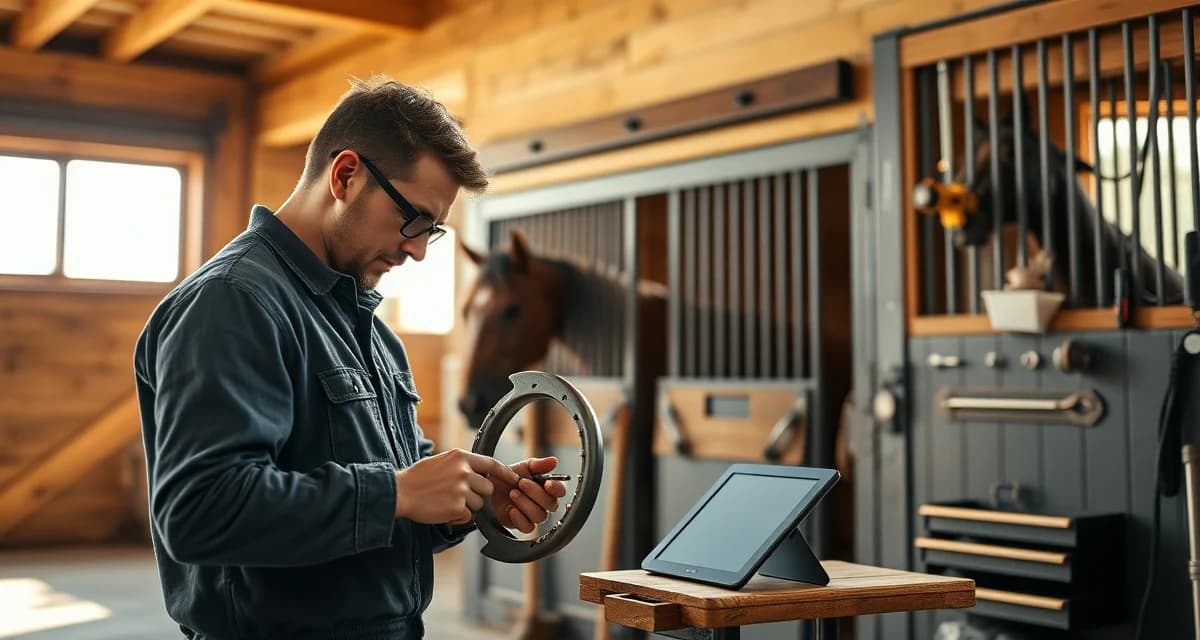
How to Set Up a Farrier Business: Licensing Pricing and First Clients
52% of new farrier businesses fail to turn profitable within 2 years without proper systems. The craft side you've already learned. The business side is what gets people. This guide covers what you need to set up, in the right order, to start running a real farrier business - not just doing farrier work.
TL;DR
- Only 4 US states require farrier-specific licensing as of 2025, but every farrier needs a business license, registered entity, and liability insurance before taking a paying client.
- New farriers who underprice earn 22% less than market rate without realizing it - start at local market rate, not below it.
- Trim-only services run $35-75 and full sets run $120-250+ depending on region; factor in $15-40 per set in materials plus travel and overhead.
- The first 20-30 clients typically come from overbooked farriers, farrier school instructors, boarding barn managers, and feed store connections - not advertising.
- Farriers who invoice same-day get paid 3x faster, and automated reminders reduce no-shows by 28% or more.
- Starting digital from day one (before your first client) prevents a painful record conversion at 80 or 150 horses later.
- FarrierIQ at $39/month costs less than a single full-set appointment and covers scheduling, invoicing, hoof records, and QuickBooks sync.
Why Systems Matter From Day One
29-52% of farriers still use paper records. That number is highest among those who've been at it less than five years - people who started with a notebook and never upgraded because it seemed to be working.
It's not working. You just don't know what it's costing you yet.
Starting digital from day one means you never build a backlog of paper records to convert, you never establish bad invoicing habits, and you build a professional reputation from the first appointment.
Step 1: Determine What Licensing You Need
Most states do not require farrier licensing. As of 2025, only four US states have any mandatory farrier regulation. The rest rely on voluntary AFA (American Farriers Association) certification.
What to do:
- Check your state's department of agriculture website for any farrier-specific requirements
- Look up your county's business license requirements for mobile service businesses
- Register a business entity (sole proprietorship is fine to start; LLC provides liability protection)
- Get business liability insurance - this is not optional. One injured horse or a fall on a client's property without coverage is catastrophic
AFA Certification: You don't need it to work, but you should pursue it. AFA Certified Farrier (CF) and AFA Journeyman Farrier (JF) certifications signal competence to clients and are often required by professional stables and sport horse operations.
Step 2: Set Up Your Business Structure
Before you take a paying client, get the paperwork right.
Business registration: Register your business name with your state. If you're operating as a DBA (doing business as), file that paperwork. An LLC gives you personal liability protection for roughly $50-200 in filing fees.
EIN: Get an Employer Identification Number from the IRS if you plan to open a business bank account or will have any employees or contractors. It's free and takes 10 minutes online.
Business bank account: Keep your business and personal finances completely separate. This is non-negotiable for tax purposes and clean bookkeeping.
Business insurance: General liability insurance for farriers typically runs $500-1,500/year. Equine professionals insurance covers specific livestock-related exposures. Get both.
Step 3: Set Your Pricing
New farriers consistently underprice. Under-priced farriers earn 22% less than market rate without realizing it.
Research local rates:
- Contact your state farrier association for regional benchmarks
- Ask 2-3 established farriers in adjacent (not competing) territories what they charge
- Check AFA's farrier compensation survey data
Typical 2025 rate ranges by service:
- Trim only: $35-75 depending on region
- Trim + reset (front): $75-120
- Full set (four shoes): $120-250+
- Corrective or therapeutic work: premium pricing - quote by case
Factor in your costs:
- Materials (shoes, nails, pads): $15-40 per set
- Travel: either built into your hourly rate or charged separately as a mileage/travel fee
- Tools and forge equipment: amortized over their useful life
- Insurance and overhead: divided across your expected visits per month
Start at market rate, not below it. You can always offer a new client incentive; it's hard to raise prices on established clients.
Step 4: Get Your First Clients
The first 20-30 clients are the hardest to land. After that, referrals do most of the work.
Start with your network:
- Other farriers who are overbooked and will refer overflow
- Your farrier school instructors (they know who's looking)
- Local feed stores and tack shops - they know horse owners
- Local boarding barns - one good barn relationship can mean 20+ horses
Do the professional things other new farriers skip:
- Have business cards
- Build a basic website with your contact information, services, and coverage area
- Be responsive - return calls and texts same day
- Show up exactly on time, every time
First appointment protocol: Document everything from the first visit. Take photos. Send an invoice immediately. This sets expectations that you're a professional operation, not a guy who'll chase you for payment later.
Step 5: Set Up Your Digital System
This is the step most new farriers skip. Don't.
Set up FarrierIQ (or another farrier-specific app) before you take your first client. Enter each horse as you book them. Send your first real invoice from the app. Connect QuickBooks.
The reason to do this from day one: if you start on paper and switch at 80 horses, you're converting records. If you start digital, you build the habit immediately and the data is clean from the beginning.
FarrierIQ at $39/month gives you everything you need: scheduling, invoicing, hoof records, QuickBooks sync. It's less than a single full-set appointment per month and it pays for itself in recovered time and cash flow within the first few weeks.
Common Mistakes When Starting a Farrier Business
Starting without insurance. One kicked person or one horse injured during your visit can cost more than you'll earn in a year.
Pricing too low to get clients. You'll attract the wrong clients and then have to raise prices later - which is harder than charging market rate from the start.
Using paper records. You'll convert eventually. The question is whether you do it at 50 horses or 150.
Not treating reminders as part of the job. Clients forget. Send reminders. Get confirmations. This reduces no-shows by 28%+ and is automated in FarrierIQ.
Letting invoices age. Invoice same-day, every day. Farriers who invoice same-day get paid 3x faster.
Related Articles
FAQ
What licenses do I need to start a farrier business?
Most states don't require farrier-specific licensing. You'll need a general business license from your local government, a registered business entity (sole proprietorship or LLC), and you should obtain an EIN from the IRS for tax purposes. Four states have farrier registration or licensing requirements - check your state's department of agriculture. AFA certification isn't legally required in most places but is professionally expected at higher-end stables and sport horse operations.
How do I find my first farrier clients?
Start with network connections: experienced farriers who have overflow, your farrier school instructors, local boarding barn managers, and feed store/tack shop owners who know active horse people. Show up professionally - on time, with business cards, invoicing on the spot. The first 20 clients usually come from a combination of word-of-mouth and making yourself known at the places horse owners spend money. After that, referrals drive most growth.
How should I price my farrier services when starting out?
Start at local market rate, not below it. Research regional pricing through your state farrier association, AFA compensation surveys, and conversations with farriers in non-competing areas. Price below market and you attract clients who'll leave you the moment someone undercuts you - and you'll struggle to raise prices later. Price at market and you build a stable client base with expectations aligned to your actual value.
Do I need an LLC or can I operate as a sole proprietor?
A sole proprietorship is legally sufficient to start, and many farriers operate that way for years. The main reason to form an LLC is personal liability protection - if a horse is injured or a client is hurt during a visit, an LLC separates your personal assets from the business. Filing fees run $50-200 in most states, which makes it a low-cost safeguard worth doing before you build a full client list.
How do I handle clients who are slow to pay?
Invoice the same day as the appointment, every time. Farriers who invoice same-day get paid 3x faster than those who batch invoices weekly or monthly. If a client is consistently late, require payment at the time of service going forward. Farrier business software like FarrierIQ automates invoice delivery and follow-up reminders, which removes the awkwardness of chasing payments manually and keeps your cash flow predictable.
When should I start tracking hoof records for each horse?
From the very first appointment. Hoof condition, shoe type, nail pattern, and any corrective work done at visit one becomes the baseline for every future visit. Without that record, you're starting from scratch each time and missing the longitudinal data that makes you more valuable to clients over time. Digital hoof records also protect you if a client ever disputes your work or a horse develops a condition they attribute to your shoeing.
Sources
- American Farriers Association (AFA) - farrier compensation surveys, certification standards, and industry statistics
- United States Small Business Administration (SBA) - guidance on business registration, EIN applications, and LLC formation
- National Agricultural Statistics Service, USDA - equine industry data and livestock-related business benchmarks
- University of Minnesota Extension, Equine Program - equine business management and farrier industry resources
- Internal Revenue Service (IRS) - Employer Identification Number registration and self-employment tax guidance for mobile service businesses
Get Started with FarrierIQ
Setting up your farrier business the right way from day one means you never have to untangle a paper record backlog, chase late invoices, or rebuild your pricing structure after undercharging for a year. FarrierIQ gives you scheduling, hoof records, same-day invoicing, and QuickBooks sync in one place for $39/month - less than a single full-set appointment. Start your free trial and have your digital system ready before your first client appointment.