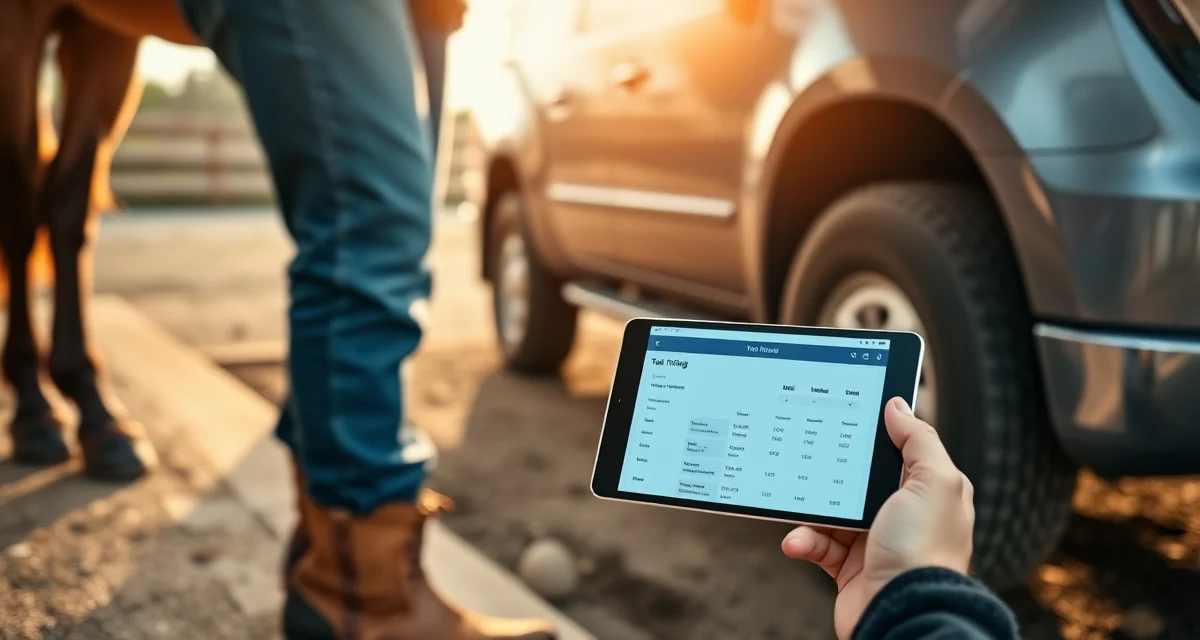
Farrier Mileage Tracker: Log Every Mile for Tax Deductions Automatically
Farriers who track mileage claim an average of $4,100 more in annual deductions than those who don't. That's not a rounding error. That's a real difference in what you pay to the IRS every spring.
The problem isn't that farriers don't know mileage is deductible. Everyone knows that. The problem is that tracking it manually is painful, and most people eventually stop. You forget to write down the start reading. You lose the notebook. You try to reconstruct a month's worth of trips from memory on a Sunday night in April and give up.
A farrier mileage tracker that runs automatically solves all of that.
TL;DR
- Farriers who track mileage claim an average of $4,100 more in annual deductions than those who don't -- at the 2025 IRS standard rate of 67 cents per mile, 25,000 business miles is a $16,750 deduction.
- The IRS requires a contemporaneous mileage log with date, start location, destination, miles, and business purpose -- logs reconstructed from memory don't meet the standard and create audit risk.
- FarrierIQ tracks mileage automatically tied to scheduled appointments -- no manual entry, no notebook to lose, and an IRS-ready export at year's end in one tap.
- The app works offline, so mileage tracking continues in rural dead zones where farriers spend most working hours -- data syncs automatically when coverage is restored.
- Deductible mileage includes drives between client farms, supply store trips, farrier association events, and vet coordination drives -- the commute from home to first stop is generally not deductible, with exceptions.
- Standard mileage rate (simpler, fewer records) is the right choice for most farriers; actual expense method can yield larger deductions for high-cost vehicles but requires receipts for every vehicle expense.
- Farriers who consistently round their mileage log entries (every trip is exactly 15 miles, every day exactly 80 miles) trigger audit scrutiny -- actual driving produces varied numbers that look natural.
Why Mileage Is Your Biggest Tax Deduction
When you drive from farm to farm, every mile is a deductible business expense. The IRS standard mileage rate for 2023 was 65.5 cents per mile. A farrier driving 25,000 business miles per year would be looking at a deduction of more than $16,000.
That's not taxable income. That's money that never gets counted against you.
But you can only claim miles you've documented. The IRS requires a mileage log with the date, start location, destination, miles driven, and business purpose for each trip. Without that, you're guessing, and guesses don't hold up.
What Counts as Deductible Farrier Mileage
Not every mile you drive is deductible. The basic rule: miles driven for business purposes are deductible. Miles driven for personal purposes are not.
For farriers, deductible miles include:
- Driving from home (or your first stop) to client farms
- Driving between farms during your work day
- Driving to the farrier supply store to pick up materials
- Driving to continuing education or farrier association meetings
- Driving to vet appointments as part of therapeutic care coordination
Non-deductible: your commute from home to your first stop is generally considered personal by the IRS (though there are exceptions if your home is your principal place of business, so talk to your accountant).
The Problem With Manual Mileage Tracking
Paper mileage logs have been around forever. They work in theory. In practice, they fail for most people because:
You forget to write it down. You're at a barn, you just finished a tough shoeing job, there's a horse owner asking questions, and the last thing on your mind is writing down your odometer reading.
You lose the log. Notebooks get left in trucks, get wet, get buried under equipment.
You try to catch up from memory. When you do sit down to fill in the log, you're guessing at details. Guessed logs don't hold up under audit.
You undercount. When you're estimating rather than recording, you typically underestimate. That means you're leaving deductions unclaimed.
An automatic GPS mileage tracker eliminates every one of these problems.
How FarrierIQ's Automatic Mileage Logging Works
FarrierIQ tracks your mileage automatically, tied to your scheduled appointments. When your day starts, the app logs your route between farm stops. Every mile is recorded with a timestamp, start and end location, and the appointment it's connected to.
There's no manual entry. No remembering. No reconstruction at tax time.
At year's end, you export an IRS-ready mileage report directly from the app. It includes every business trip, properly documented in the format the IRS expects. You hand it to your accountant or attach it to your Schedule C and you're done.
The app also works offline, so tracking continues even when you're in areas with no cell signal. Your data syncs when you're back in range. See the full farrier tax records guide for how mileage fits into your complete tax picture.
Standard Mileage Rate vs. Actual Expense Method
You have two options for how you deduct vehicle expenses:
Standard mileage rate: Multiply your documented business miles by the IRS rate (adjusted annually). Simple math, minimal paperwork beyond the mileage log.
Actual expense method: Add up your real vehicle costs (gas, insurance, maintenance, registration, depreciation) and deduct the business-use percentage. More documentation required, but sometimes results in a larger deduction.
Most farriers use the standard mileage rate because it's simpler and the documentation requirement is just the mileage log. If you want to use the actual expense method, you also need to track the business-use percentage of your vehicle, which requires the same mileage log plus receipts for every vehicle expense.
You have to choose one method and stick with it for as long as you own the vehicle (with some exceptions). Talk to your accountant about which makes more sense for your situation.
Does the App Work Offline?
Yes. FarrierIQ tracks mileage offline, which matters because rural barns, where farriers spend most of their working hours, frequently have no cell signal. The app stores all tracking data locally and syncs when connectivity is restored.
The farrier offline app functionality extends to mileage tracking, so your records are complete even when you're working in dead zones.
How to Get Started
Setting up mileage tracking in FarrierIQ takes about two minutes:
- Enable mileage tracking in the app settings
- Set your home location as the starting point
- Confirm your scheduled appointments are entered in the system
That's it. The app handles the rest.
At any point during the year, you can pull a mileage summary to see how you're tracking. At year's end, export the full report in one tap.
FAQ
How do farriers track mileage for taxes?
The IRS requires a contemporaneous mileage log documenting the date, start and end locations, miles driven, and business purpose of each trip. You can maintain this manually in a notebook or spreadsheet, but most farriers find automatic GPS tracking far more reliable. A dedicated farrier mileage tracker tied to your scheduling app records every trip automatically without any manual input.
What mileage can a farrier deduct?
Farriers can deduct miles driven between client farms, to supplier or supply store trips, to professional development events, and to other business-related destinations. The trip from home to your first farm stop is generally not deductible (treated as a commute), though there are exceptions if your home qualifies as your principal place of business. The best approach is to track all business-related miles and let your accountant advise on what's deductible in your specific situation.
Does mileage tracking app work offline?
FarrierIQ's mileage tracking works offline. The app logs all trip data locally on your device and syncs to the cloud when you reconnect. This is important for farriers who work in rural areas where cell signal is unreliable or nonexistent. Your mileage records are complete regardless of connectivity.
How do I know if my mileage log would hold up in an IRS audit?
An IRS-compliant mileage log needs five elements for each trip: date, starting location, destination, business purpose, and miles driven. Logs that omit any of these elements -- particularly the destination and business purpose -- do not satisfy the IRS standard. FarrierIQ's mileage export includes all five elements automatically for every trip tied to a scheduled appointment. Cross-referencing your mileage log with your appointment records in FarrierIQ (which show the same client names, dates, and locations) creates a corroborating record that significantly strengthens your position in an audit. The farrier tax records guide covers the full documentation set that makes your tax position defensible.
The Math Is Simple: Track It
If you drive 20,000 business miles per year and don't track them, you're potentially missing $13,100 in deductions at the current IRS rate. If your combined tax rate is 25%, that's $3,275 extra you'd pay to the IRS that you didn't have to.
The app is free to try. The tracking is automatic. There's no good reason not to start today.
Sources
- Internal Revenue Service (IRS), Publication 463: Travel, Gift, and Car Expenses
- American Farrier's Association (AFA), farrier business management and tax guidance resources
- IRS Revenue Procedure 2019-46, standard mileage rate and mileage log requirements
- Small Business Administration (SBA), vehicle expense deduction guidelines for self-employed workers
Get Started with FarrierIQ
Farriers who track mileage claim an average of $4,100 more in annual deductions -- FarrierIQ's automatic mileage logging tied to your scheduled appointments requires no manual entry, works in rural offline zones via the farrier offline app, and exports an IRS-ready report at year's end in one tap. Try FarrierIQ free and enable mileage tracking before your next work day.