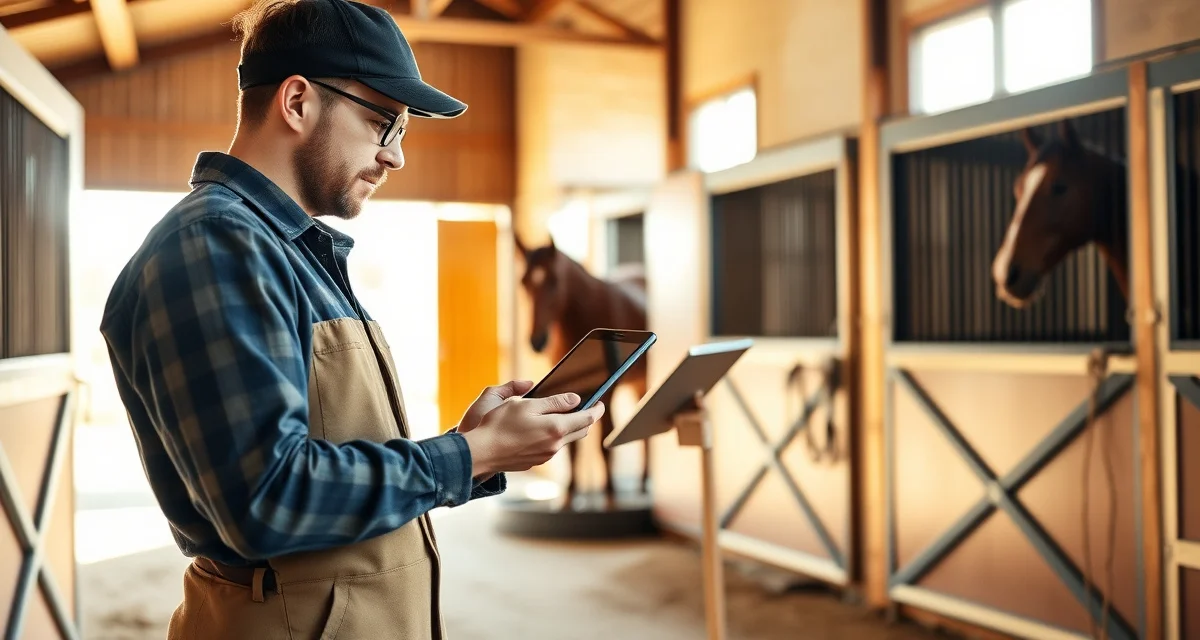
Solo Farrier Software: Run Your Entire Business From Your Phone
Running a one-person farrier business means you wear every hat. You're the farrier, the scheduler, the bookkeeper, the route planner, the accounts receivable department, and the person who fields every client call. Solo farriers spend an average of 2.3 hours per day on non-hoof-care administrative tasks. That's time you're not getting paid for, and in many cases it's time at the end of a long day when you're tired and ready to stop.
TL;DR
- Solo farriers average 2.3 hours per day on admin tasks - the right software cuts that to minutes per task
- Farriers driving unoptimized routes waste an average of 37 extra miles per week, costing roughly $450/year in fuel alone
- Invoicing same-day gets you paid an average of 11 days faster than end-of-day or end-of-week billing
- The average farrier carries $1,200–2,800 in outstanding invoices at any given time - integrated invoicing reduces that gap substantially
- Automated appointment reminders reduce last-minute cancellations by 68%
- FarrierIQ's solo plan at $49/month typically pays for itself within the first month for farriers managing 50+ horses
- 60% of solo farriers still rely on paper and spreadsheets, handling every admin task separately and inefficiently
The right software cuts that admin time dramatically. Not by eliminating the work -- invoices still have to go out and schedules still need to be managed -- but by making each task take minutes instead of an hour.
What Solo Farrier Software Actually Needs to Do
Let's be honest about what you're actually doing on the administrative side. On any given day, a solo farrier might need to:
- Check who's on the schedule for today and tomorrow
- Figure out the most efficient driving order through multiple barns
- Look up a horse's shoeing history before a visit
- Add notes after a visit while they're still fresh
- Create and send an invoice for today's work
- Follow up on a payment that's a week late
- Respond to a client asking when their horse is due
- Book a new client who called this afternoon
Paper and spreadsheets used by 60% of solo farriers mean all of these tasks happen separately, often inefficiently, and sometimes not at all when things get busy. An invoice that doesn't go out until Friday for work done Monday. A new client who asked to be called back and got lost in the mental shuffle. A follow-up call for a late payment that you keep meaning to make.
Good software turns these into quick tasks rather than interruptions that eat your day.
Scheduling: Set It and Forget It
The scheduling feature that makes the biggest difference for solo farriers isn't booking new appointments -- it's automating the re-booking of existing ones. Most of your client base is on a recurring schedule. A horse you see every 6 weeks should have their next appointment automatically queued up when you finish the current one.
FarrierIQ's interval scheduling does this. When you complete a visit, the next appointment is already proposed based on that horse's established interval. You confirm it, the client gets an automatic reminder, and you move on. The recurring part of your schedule runs itself.
For new clients or one-off bookings, you add them manually. But the bulk of your weekly schedule -- the regular clients you've been seeing for years -- should never require manual re-entry.
The other scheduling feature that matters is overdue horse alerts. If a horse is coming up on their interval and no appointment is booked, the system flags it. You stay ahead of the schedule rather than discovering gaps when clients call wondering where you are. This is especially useful when you're managing a full client roster across multiple barns.
Route Planning: Stop Adding Miles
Without a route planning tool, most solo farriers drive based on habit and geography they already know. You roughly cluster by area, but you're probably not driving the optimal sequence. Farriers driving unoptimized routes average 37 extra miles per week compared to routes that are actually optimized.
At $3.50/gallon in a truck that gets 15 miles per gallon, 37 extra miles a week is about $9 in fuel. Doesn't sound like much until you multiply it across 50 weeks: $450/year in fuel alone, plus the extra time in the truck. And that's the conservative estimate.
FarrierIQ's route optimization takes your day's appointments and builds the most efficient driving sequence automatically. You enter where you're going; it figures out the order. On a day with eight barn stops, that can mean shaving 20-30 minutes off your drive time in addition to the fuel savings.
Invoicing: Bill Before You Leave
Paper invoices and end-of-day billing delay payment. Farriers who invoice same-day collect an average of 11 days faster than those who don't. Over the course of a year, that difference in your cash flow is real.
The goal with solo farrier invoicing is to get it done at the barn, before you drive away. FarrierIQ's one-tap invoicing lets you pull up the horse's record, select the services, and send a professional invoice to the owner's email or phone in under a minute. The owner gets a payment link they can use immediately.
If they pay with a card stored on file -- which FarrierIQ supports -- the payment processes automatically and you don't have to think about it again. If they pay later, you have an electronic record and can send an automatic reminder if payment is late.
No more tracking who owes what in your head. No more finding a handwritten invoice three weeks old at the bottom of your bag. The average farrier has $1,200-2,800 in outstanding invoices at any given time. Good farrier invoicing software reduces that gap substantially.
Horse Records: The Details That Pay Off
Solo farriers sometimes skip detailed records because they carry a lot in their head. You've been seeing most of your horses for years; you know their quirks. But what happens when you can't remember whether you used a 00 or 000 on the front right? What do you tell a client who asks why their horse is moving differently than they were two months ago?
Digital records aren't about doubting your memory. They're about having information instantly available when it matters, and building a professional record that clients can see and value.
FarrierIQ's horse records are fast to fill in because they're designed around farrier workflows. You're not entering data into a generic database -- you're filling in fields built for hoof care: shoe type, size per hoof, condition notes, photos. It takes 3-4 minutes per horse to document a visit, and those three minutes save you time later when you need the information.
Connect your records to your farrier scheduling software so that when you pull up tomorrow's schedule, you can tap through to each horse's record and review their last visit before you arrive. You show up prepared instead of trying to reconstruct what you did six weeks ago when you're already at the barn.
Client Communication: Stop Playing Phone Tag
As a solo farrier, client communication is pure overhead. Every call you make about an upcoming appointment, every reminder you send, every follow-up for a late payment is time spent not working. You need these things to happen automatically.
FarrierIQ's automated reminders send text or email confirmations to clients before their scheduled appointment. Clients can confirm or request rescheduling directly, which means you know your schedule is locked in before you're driving to the barn. Farriers using automated reminders see a 68% reduction in last-minute cancellations.
For late payments, automatic payment reminders go out at whatever interval you set. You don't have to make the awkward call; the system handles the follow-up and only escalates to you if the payment still hasn't come in after multiple reminders. Setting up automated client reminders for farriers takes just a few minutes in FarrierIQ and runs in the background from that point on.
The $49/Month Question
FarrierIQ's solo plan is $49/month. Is it worth it?
Run the math. If route optimization saves you 30 minutes of drive time per day and you work 200 days a year, that's 100 hours back. At $80/hour for your time, that's $8,000/year in recovered productivity. If faster invoicing brings in even one additional payment per month that you'd previously let slip, that's another $80-150/month.
The question isn't whether software is worth $49/month. It's whether the admin time you're spending right now is worth what it's costing you in terms of horses you could be seeing, hours you're losing, and revenue that's not being captured.
For solo farriers managing 50+ horses, FarrierIQ typically pays for itself within the first month. For context on how it compares to running a small team, see the farrier business management guide.
Frequently Asked Questions
What software should a solo farrier use?
Solo farriers need software that handles scheduling, invoicing, route optimization, horse records, and client communication in a single mobile app that works offline. FarrierIQ's solo plan at $49/month covers all of these. The key criteria are offline capability (most barns have poor cell coverage), mobile-first design (you're not going to a desktop during a workday), and integrated invoicing (billing from a separate app introduces friction that results in delayed payments).
Is there an affordable app for a one-person farrier business?
FarrierIQ at $49/month is the most complete affordable option for solo farriers. For context, a solo farrier managing their own invoicing, route planning, and scheduling through separate free tools typically spends 2-3 hours more per day on admin than one using integrated software. At $80/hour, that's $160-240/day in opportunity cost. The software pays for itself quickly when the time savings are factored in.
Can solo farrier software handle invoicing and scheduling together?
Yes -- and that integration is what makes the workflow efficient. FarrierIQ connects scheduling and invoicing so that when you complete a scheduled visit, creating an invoice from that appointment pulls in the horse's information, the services scheduled, and the client's contact details automatically. You're not re-entering information that's already in the system. The invoice goes out in under a minute, and payment can be collected via stored card or payment link immediately.
Does FarrierIQ work without cell service at the barn?
Yes. FarrierIQ is built with offline functionality specifically because most barns and rural properties have unreliable or no cell coverage. You can access horse records, complete visit notes, and create invoices while offline. Everything syncs automatically once your phone reconnects to a network. This is one of the most important practical differences between farrier-specific software and general business apps that assume a constant internet connection.
How long does it take to get set up on FarrierIQ as a solo farrier?
Most solo farriers are fully operational within a few hours. The initial setup involves importing or entering your existing client and horse list, setting recurring intervals for your regular horses, and configuring your invoice template with your business name and payment preferences. FarrierIQ's onboarding is designed for one-person operations, not large teams, so there's no complex configuration required before you can start using it on a real workday.
What happens to my horse records if I cancel my subscription?
FarrierIQ allows you to export your horse records, client data, and invoice history at any time, including before canceling. Your data is yours. It's worth asking this question of any software you consider, since some platforms make data export difficult or charge for it. For a solo farrier who has built years of hoof care records, data portability is a practical concern worth confirming upfront.
Related Articles
Sources
- American Farriers Journal, Lessiter Media - industry research and farrier business surveys
- Brotherhood of Working Farriers Association (BWFA) - farrier certification standards and professional resources
- American Association of Equine Practitioners (AAEP) - equine hoof care guidelines and veterinarian-farrier collaboration resources
- U.S. Small Business Administration (SBA) - small business invoicing, cash flow, and accounts receivable best practices
- Rutgers Equine Science Center, Rutgers University - equine hoof health research and farrier education resources
Get Started with FarrierIQ
If you're a solo farrier spending hours each week on scheduling, invoicing, and chasing payments, FarrierIQ's $49/month solo plan gives you every tool covered in this guide in a single offline-ready mobile app. Try it free and see how much admin time you recover in the first week alone.